25 Tiny Japanese Tattoos Idea That Feel Like Art
You know that feeling when you see a tattoo so small and so perfect it almost takes your breath away?
That is exactly what tiny Japanese tattoos do.
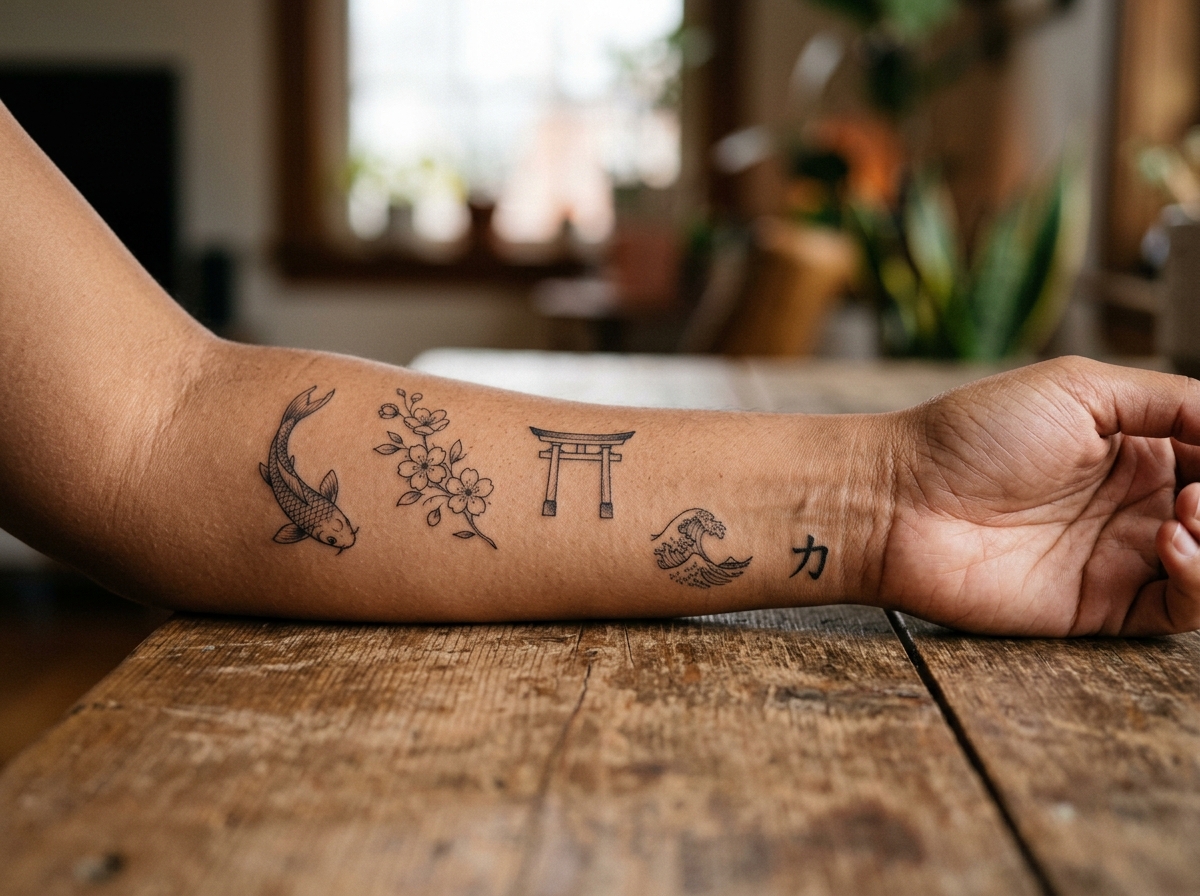
They do not need to be big to say something. A tiny koi fish on your wrist. A single cherry blossom behind your ear. A mini torii gate tucked on your ankle. These little pieces carry so much.
Japanese art has been around for centuries. The images, the symbols, the brushstroke style — all of it carries layers of meaning that go way deeper than what you see on the surface.
And when you shrink that art down to something small enough to fit on your finger or your collarbone? It becomes something almost magical.
Tiny Japanese tattoos are having a serious moment right now. And it makes total sense.
People want tattoos that feel intentional. Thoughtful. Not just cool-looking, but connected to something real. Japanese art gives you that. Every motif has a story. Every symbol has roots.
The koi fish stands for strength and persistence. The crane stands for longevity and good fortune. The wave reminds you that life has its highs and its lows, and you ride them anyway.
And all of that? Packed into something no bigger than your thumbnail.
This style also works beautifully in fine line and micro formats. The clean, precise linework of Japanese art translates so well at a tiny scale.
You get all the detail. All the feeling. None of the overwhelm.
So if you have been looking for a small tattoo that actually means something, you are in the right place.
Here are 25 tiny Japanese tattoos that are straight-up stunning — and small enough to keep close, wherever you go.
25. Mini Torii Gate
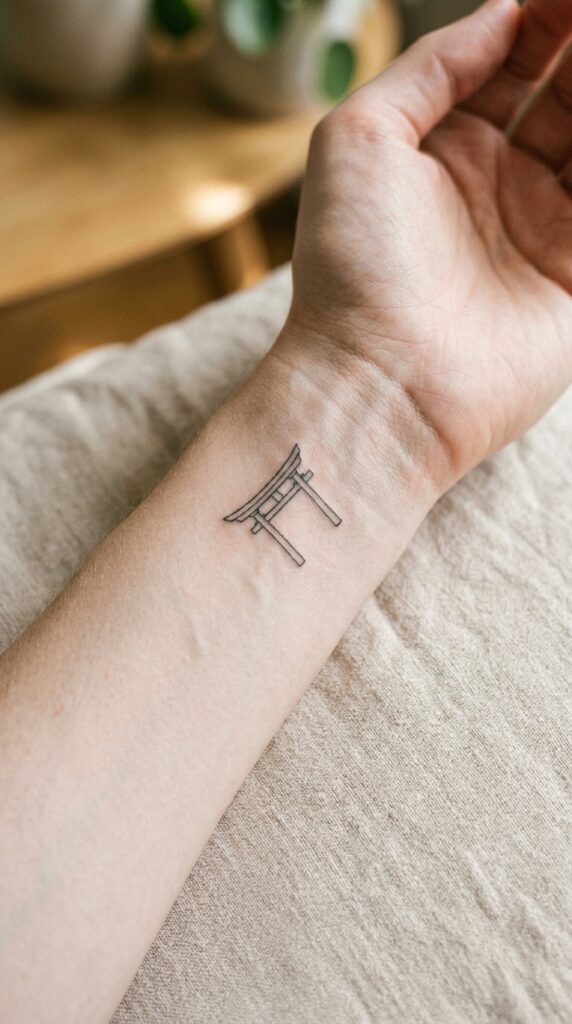
A tiny torii gate sits on the skin like a little doorway to somewhere sacred.
The two upright posts and the gently curved crossbar on top are so clean and precise.
At this small size, fine lines do all the work. There are no fillers, no shading tricks. Just the gate, standing there quietly on your wrist.
It looks like it was drawn by a steady hand and a lot of care.
The torii gate marks the entrance to a Shinto shrine in Japan. It is the line between the everyday world and something spiritual.
People get this tattoo as a reminder that there is always a threshold to cross. A moment where you step from one version of yourself into another.
It does not need to be loud about that. The gate is small. The meaning is not.
Some people pair it with a single line underneath to represent the path leading up to it. That tiny addition makes the whole design feel like a scene.
You can also get it completely standalone. Just the gate. Simple, sharp, and full of quiet meaning.
If you love Japanese culture, travel, or the idea of sacred spaces, this one lands every single time.
It sits perfectly on the inner wrist where you catch a glimpse of it every time you reach for something.
That daily reminder? That is the whole point.
- Best Placement: Inner wrist, 2 cm tall | Behind the ear, 1.5 cm tall
- Inspiration: The space between the ordinary and the sacred.
24. Single Cherry Blossom
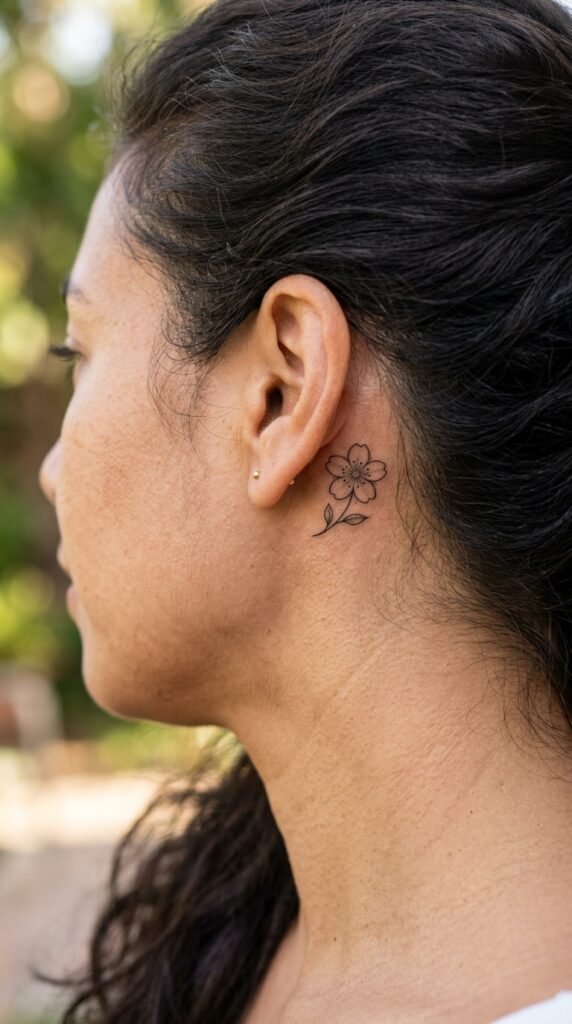
One cherry blossom. Five petals. A tiny dot cluster at the center.
That is all it takes, and it is already stunning.
At micro size, every line has to count. The petals have a soft, rounded shape with a slight notch at the tip. The linework is so precise it looks like it was painted with a brush the size of a hair.
Behind the ear is the perfect home for this one. You catch it only when someone looks closely.
Cherry blossoms in Japan are called sakura, and they bloom for only a short time each spring. That brief bloom is the whole point.
In Japanese culture, this flower represents the beauty of things that do not last. Life is short. Moments pass. And that is not sad — it is what makes them worth noticing.
People who get a single cherry blossom tattoo often connect it to someone they lost, a season of life that changed them, or just a personal reminder to be present.
It is one of those tiny Japanese tattoos that carries real emotional weight.
And because it is so small and simple, it never feels heavy on the skin. It just lives there quietly, like a little note to yourself.
You can tuck it behind your ear, on your ankle, or on the soft inside of your arm. It works anywhere.
It also ages beautifully in fine line. A healed cherry blossom tattoo takes on a slightly softer quality over time that actually adds to the look.
- Best Placement: Behind the ear, 1 cm wide | Inner ankle, 1.5 cm wide
- Inspiration: Beauty lives in the things that do not stay forever.
23. Koi Fish (Micro)
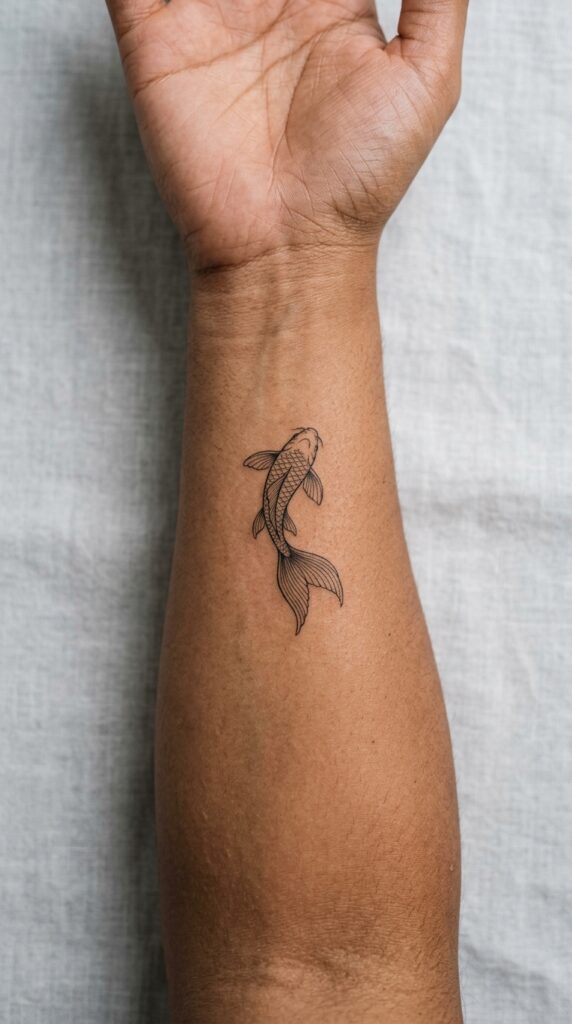
A micro koi fish swims upward on the inner forearm, and it immediately draws your eye.
The body is curved and fluid. Tiny curved lines suggest scales without filling them in. The tail fans out at the bottom. The fins are light, almost wispy.
All of it is done in black fine line at a size no bigger than your thumb.
It looks precise and alive at the same time.
Koi fish in Japanese culture are one of the most iconic symbols around. They swim upstream against the current. They fight their way forward.
The story goes that a koi fish who swims to the top of a waterfall transforms into a dragon. So this small fish is really a symbol of massive ambition.
People get koi tattoos when they are going through something hard. A rough season, a personal comeback, a goal they have been chasing for a long time.
A micro koi keeps that energy close without announcing it to the whole room.
It is just between you and your skin.
The upward-swimming direction is the most popular because it represents moving forward, pushing through. Some people flip it downward to show that they are going with the flow instead of fighting it. Both are valid.
At this size, a skilled micro tattoo artist can capture the koi’s movement beautifully. The trick is choosing someone who specializes in fine or micro work, because the detail is everything here.
On the inner forearm, the koi looks incredible when the arm is extended. Like it is swimming out toward the world.
- Best Placement: Inner forearm, 3–4 cm tall | Back of the neck, 2.5 cm tall
- Inspiration: For the ones who keep swimming no matter what.
22. Mt. Fuji Outline
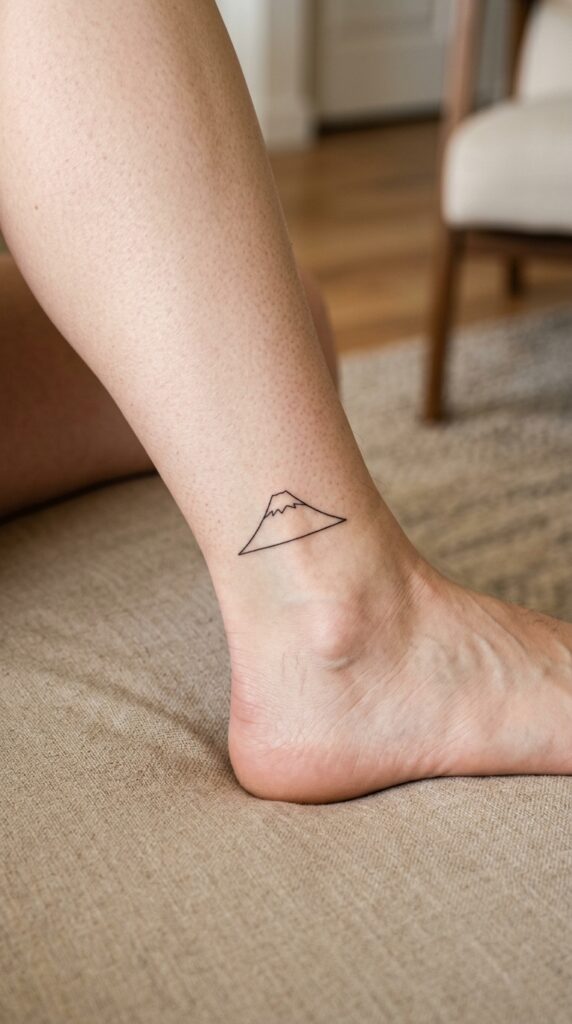
The outline of Mt. Fuji is one of the most recognizable silhouettes in the world.
At tiny scale, it becomes something almost geometric. A clean peak. Sloping sides. A small flat line near the top to suggest snow. No fill, just the outline.
It sits on the ankle like a little landmark, and it is instantly identifiable even at 2 cm wide.
Japan’s most famous mountain has been a symbol of strength, endurance, and spiritual power for centuries.
Mt. Fuji appears in countless Japanese woodblock prints and paintings. It is associated with the Japanese concept of perseverance something that stands firm no matter what surrounds it.
For many people, this tattoo is a love letter to Japan. A country they visited, a place that changed them, or a culture they deeply respect.
For others, it is about the idea of the mountain itself. Something immovable. Something you can always return to.
The ankle is a great spot because it is visible in sandals and bare feet, but easy to cover otherwise.
It also works beautifully on the collarbone, horizontally placed. That version feels more delicate and poetic.
Because the design is so clean and geometric, it stays sharp for a long time even in fine line. The simple shapes hold well as the tattoo ages.
If you want to add a tiny sun rising behind the peak, that is a nod to the Japanese flag and adds a warm layer of meaning. But even alone, this outline says everything.
- Best Placement: Outer ankle, 2 cm wide | Collarbone, 2.5 cm wide
- Inspiration: Steady and still while everything around you shifts.
21. Great Wave Mini
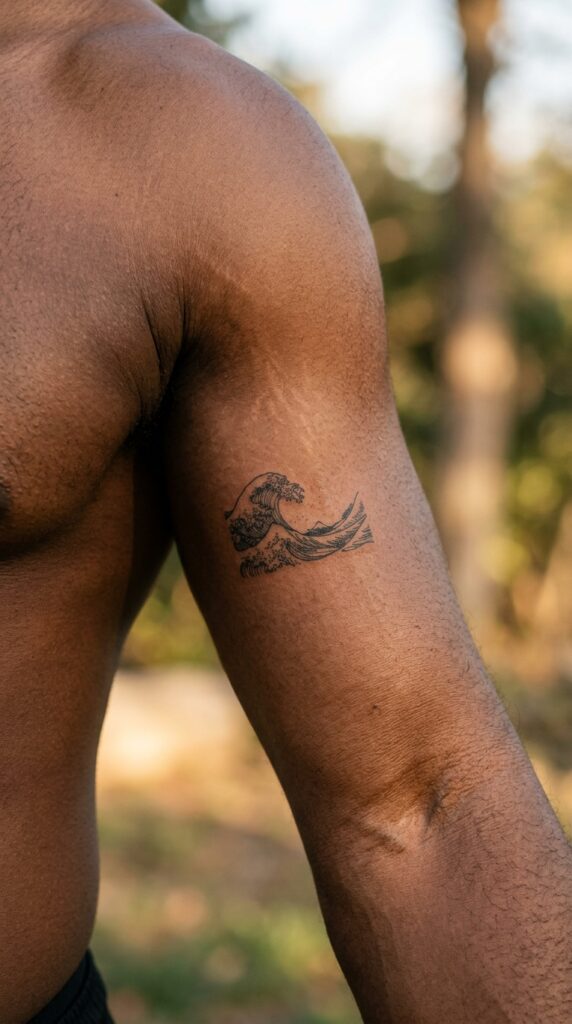
The Great Wave by Hokusai is one of the most famous images ever made.
In mini form, it becomes a tiny, dramatic scene living on your skin. The curling crest of the wave tips forward, the foam fingers reach out at the top, and tiny Mt. Fuji peeks out in the background.
All of this fits in a space smaller than a matchbook.
The linework is dense and intentional. The wave has movement even though it is not moving. A skilled fine line artist can pack real detail into this at micro scale.
Katsushika Hokusai created this image in the 1830s. It was part of a series about Mt. Fuji, and it became one of the most reproduced artworks in history.
The wave has always carried a feeling of raw power meeting quiet stillness. The mountain in the background does not flinch. The wave crashes, and the mountain remains.
People connect to that image in all kinds of ways. The wave as chaos. The mountain as calm. Life as both.
Getting a mini Great Wave tattoo is a way of carrying that story with you every day.
It is also just a beautiful image. Even if you set the meaning aside, it is one of the most visually satisfying compositions in all of art history. In fine black line, it translates perfectly.
The upper arm and the forearm are both strong spots. You want a slightly wider placement to let the horizontal composition breathe.
- Best Placement: Outer upper arm, 4 cm wide | Inner forearm, 3.5 cm wide
- Inspiration: Power on the surface, stillness underneath.
20. Crane in Flight
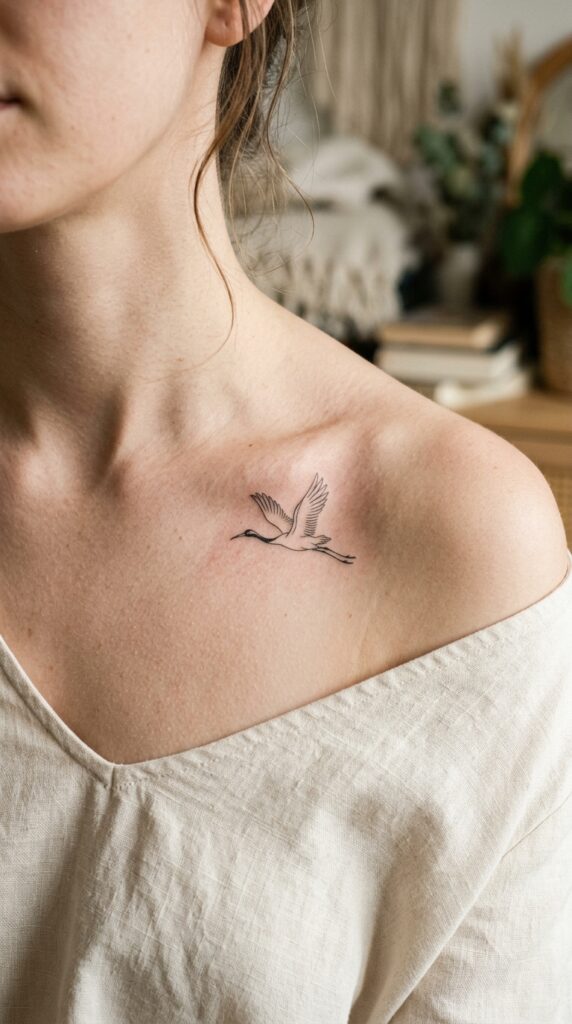
A crane with its wings fully open, neck stretched forward, legs trailing behind.
Even at a tiny size, the shape is unmistakably graceful.
The lines are long and clean. The wingspan creates a gentle horizontal composition that flows beautifully along the collarbone. The body of the crane is minimal, just enough detail to read perfectly at this scale.
It looks like it was drawn in one slow, confident stroke.
The Japanese crane, called the tsuru, is one of the most sacred birds in Japanese culture. It is said to live for a thousand years.
The crane represents longevity, good fortune, and fidelity. It is also tied to the famous legend of senbazuru — the belief that anyone who folds one thousand origami cranes will be granted a wish.
A flying crane in particular carries a feeling of freedom. Going somewhere. Rising above.
People get this tattoo to mark a new beginning, to honor a long life well-lived, or simply because they love what the crane stands for.
The collarbone is one of the best placements for this one. The horizontal wingspan follows the natural line of the bone and looks intentional and elegant.
It also works beautifully on the shoulder blade, where the bird appears to lift off your back.
In fine line black ink, this tattoo has a quiet beauty that holds up for years. The simple silhouette does not rely on shading or fill, so it stays crisp and clean.
- Best Placement: Collarbone, 4–5 cm wingspan | Shoulder blade, 3–4 cm wingspan
- Inspiration: Rising, always rising.
19. Origami Crane
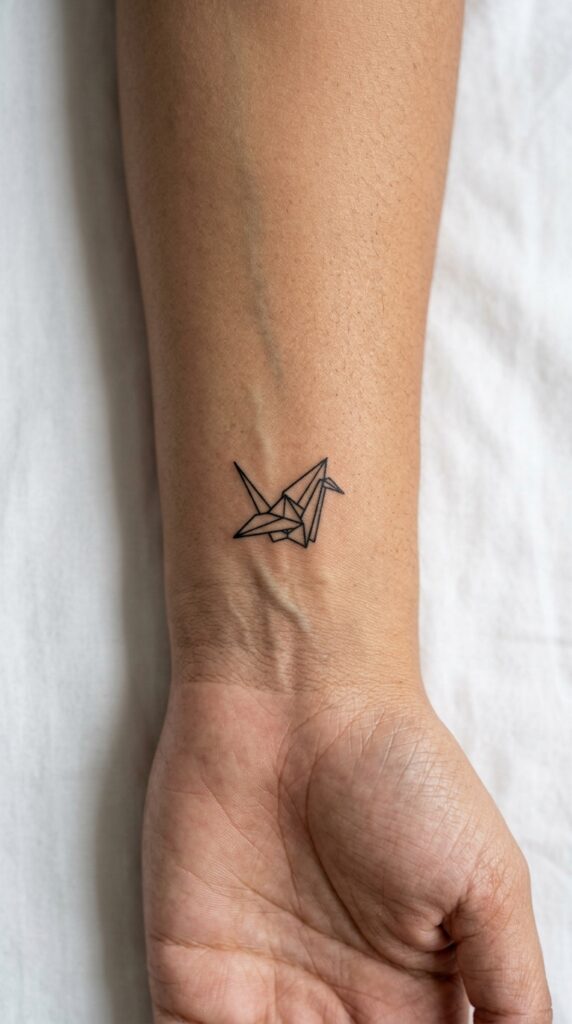
The origami crane is geometric, angular, and completely distinct from the real bird version.
It has sharp folded wings, a pointed beak, a pointed tail. The lines meet at precise angles. It looks like a paper fold captured in ink.
At a tiny scale on the inner wrist, it is precise and surprisingly detailed for something so small.
The geometry of it makes the eye stop and look.
Origami in Japan is a practice of patience, focus, and transformation. A flat square of paper becomes something entirely different in skilled hands.
The origami crane specifically carries the meaning of the senbazuru legend, which ties it to hope, healing, and wishes.
It is also a symbol of craft itself. The care it takes to fold something perfectly mirrors the care someone puts into their own life.
People get this tattoo to honor patience. To mark a period of transformation. To carry a reminder that the process of becoming something is just as important as arriving there.
It is also just a visually satisfying tattoo. The geometric style gives it a modern edge that feels fresh and intentional alongside tiny Japanese tattoos done in more traditional styles.
On the inner wrist, it catches light whenever you move your hand. Tiny but impossible to miss.
It also works as a finger tattoo, on the side of the index finger, though that placement fades faster and needs touchups.
- Best Placement: Inner wrist, 1.5 cm tall | Side of index finger, 1 cm tall
- Inspiration: Patience and transformation, fold by fold.
18. Bamboo Stalk
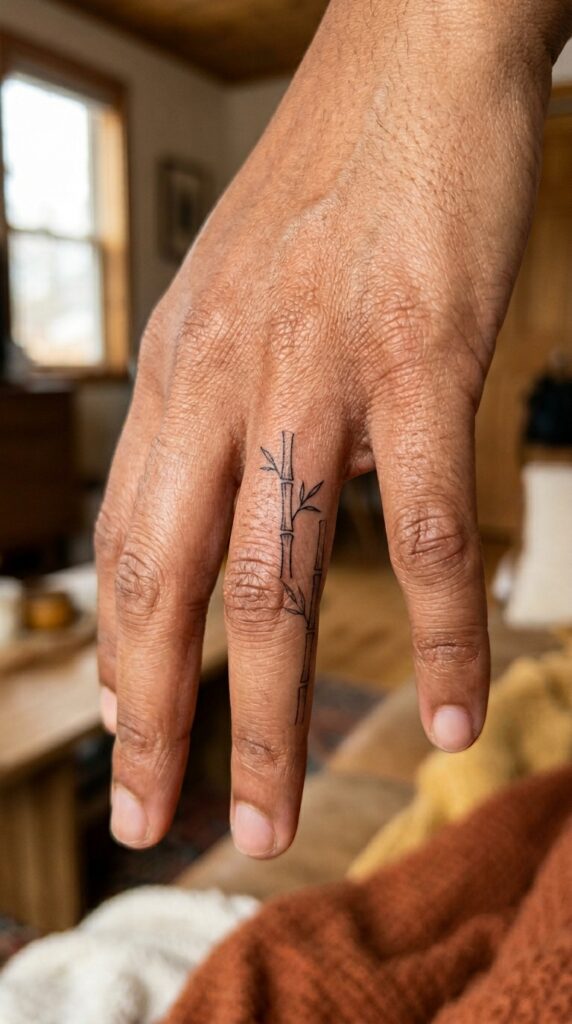
A bamboo stalk runs along the side of the finger, segmented and slim.
Three or four bamboo nodes mark the stalk with small horizontal lines. Two or three tiny leaves branch off to the side. The whole thing is clean, straight, and precise.
At this scale, every millimeter matters. The linework has to be steady and confident.
It is one of those tattoos that surprises people up close. From a distance, you might not notice it. Then you see it, and it is perfect.
Bamboo is one of the most important plants in Japanese culture and art. It appears in paintings, textiles, architecture, and poetry.
What makes bamboo meaningful is its behavior. It bends under pressure but does not break. It can grow in almost any condition. It is flexible and strong at the same time.
For people who have been through hard stretches, this tattoo speaks directly to that experience. You bent. You did not break. You kept growing.
It is also associated with simplicity and resilience. Some people get it as a reminder to stay flexible, to not resist change, to move with life rather than fight it.
The finger placement is bold and visible. Every time you gesture, you see the stalk. It is subtle but present.
You can also run it vertically along the inner forearm for a longer, more visible version that still reads as minimal and elegant.
This is one of those tiny Japanese tattoos that earns its spot by being both visually beautiful and genuinely meaningful.
- Best Placement: Side of middle or index finger, full finger length | Inner forearm, 5–6 cm tall
- Inspiration: Bend but never break.
17. Hannya Mask (Mini)
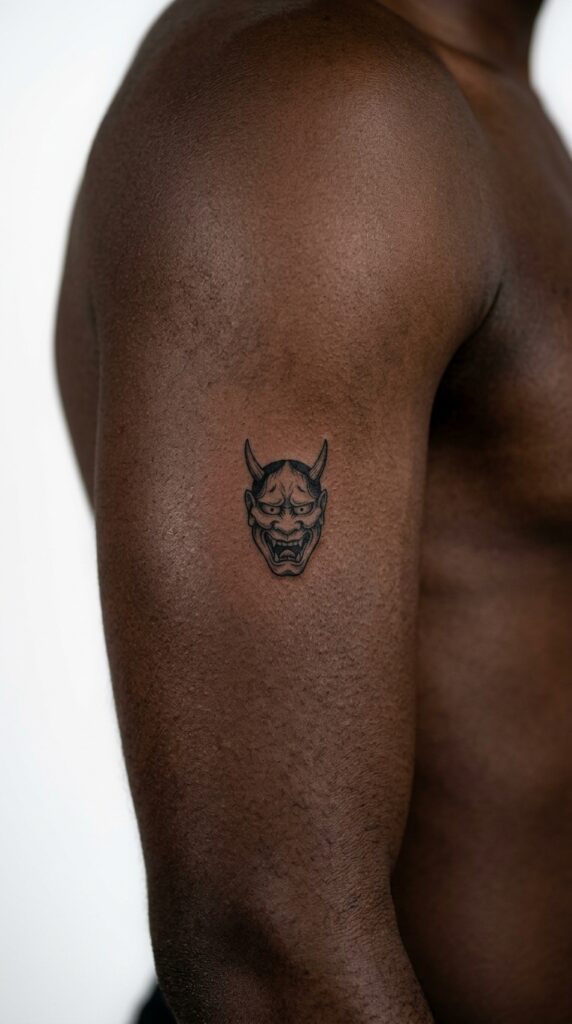
The Hannya mask is one of the most recognizable faces in all of Japanese art.
Even in miniature, it hits hard. Two small horns. Deep hollow eyes. A wide open mouth with fangs. A brow creased with emotion. At micro scale, a skilled artist packs all of this into a space the size of a coin.
It looks intense and intricate and like it should not be possible at that size. And yet, there it is.
The Hannya mask comes from Noh theatre, one of Japan’s oldest dramatic arts. It represents a woman consumed by jealousy and heartbreak who transforms into a demon.
But the mask is not just about rage. It holds grief too. Look at it closely and you can see sadness in the eyes alongside the fury.
In tattoo culture, the Hannya carries a duality. Darkness and pain, but also protection. Many people get this mask as a symbol of strength through suffering. I have been through something dark and I came out the other side.
It is also seen as a ward against evil. Something fierce enough to keep harm away.
A mini Hannya on the upper arm has serious presence. You get the impact of the design without it dominating your whole arm.
For people drawn to Japanese folklore and the edge of darker imagery, this is one of the most satisfying tiny Japanese tattoos you can get.
It rewards people who look closely.
- Best Placement: Outer upper arm, 3 cm tall | Back of calf, 3 cm tall
- Inspiration: Transformed by what tried to break you.
16. Japanese Wave Band
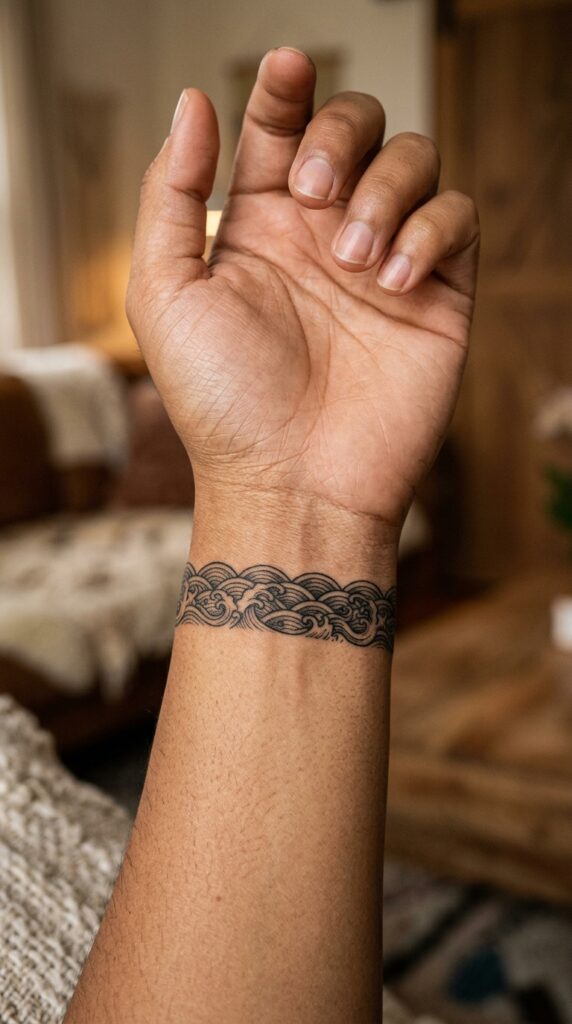
A band of Japanese waves wraps completely around the wrist, thin and continuous.
The pattern uses the classic scallop-style wave from Japanese woodblock prints. Each wave curls into itself. Tiny foam details sit at the crests. The rows repeat in a narrow band that looks almost like lacework on the skin.
At about 1 cm tall, the band has serious visual impact without taking up much space.
Up close, the detail is remarkable. From a distance, it reads as a clean, dark band.
Japanese wave patterns have been used in art, textiles, and architecture for centuries. The design is called seigaiha when it references fish scales, or namigashira when it references breaking waves. Both are ancient patterns with deep roots.
A wave band on the wrist carries the feeling of the ocean. Motion. Cycles. The rhythm of something that never stops.
For people who feel connected to water, to the sea, to the idea that things always keep moving, this tattoo feels deeply personal.
It also just looks genuinely beautiful. The pattern has an almost meditative quality when done well. Like a tiny piece of fabric woven in ink.
The wrist is the most popular placement, but this design also works on the ankle or upper arm.
Just make sure your artist has experience with repeating patterns at small scale, because consistency in the repeat is everything.
- Best Placement: Wrist band, 1 cm tall | Ankle band, 1 cm tall
- Inspiration: Life moves in waves, and that is okay.
15. Lotus Flower
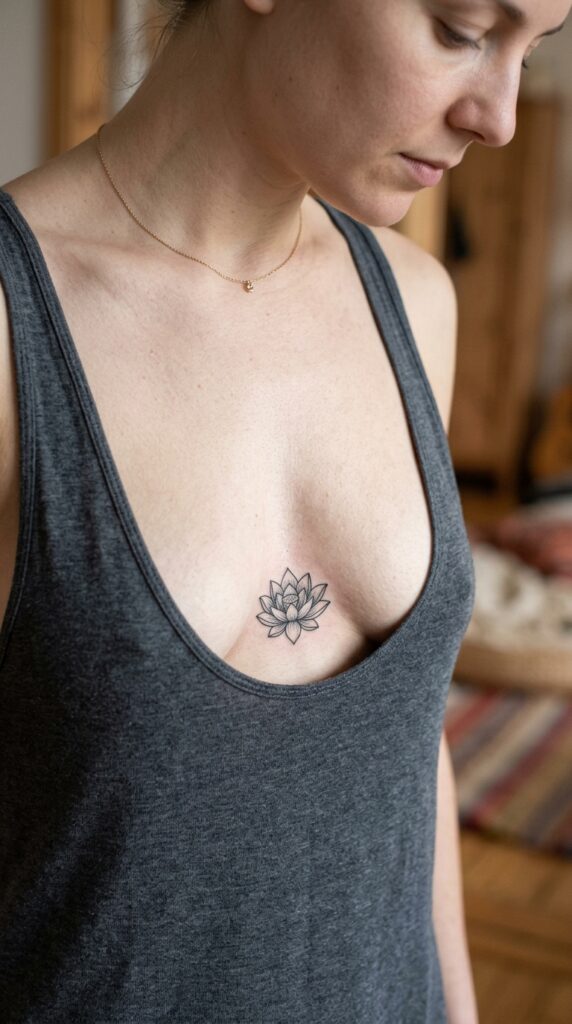
A tiny lotus flower sits centered on the sternum, petals layered and perfectly symmetrical.
The outermost petals open outward. The inner petals curve inward, tighter and more sheltered. A small seed pod circle sits at the center of the whole design.
In fine line black, every petal edge is crisp and defined. The layering creates a sense of depth even at a small size.
It is one of those tattoos that looks delicate but feels strong.
The lotus grows in muddy water. It rises up through the murk and blooms clean and open above the surface.
That is the whole metaphor, and it is a powerful one. You come from difficult conditions. You do not let them define you. You bloom anyway.
In Japanese and broader East Asian spiritual traditions, the lotus is tied to purity, enlightenment, and the idea of rising above suffering.
People who have been through real hardship often connect strongly with this image.
The sternum placement makes it personal and intimate. It sits right over your chest, close to the heart. You do not show it to just anyone.
It also works beautifully on the inner wrist, the upper back between the shoulder blades, or the nape of the neck.
At 2 to 3 cm wide, the lotus has enough room for the petal layers to read clearly without crowding together.
Pair it with a single thin stem below the flower and it becomes a full composition that is still completely minimal.
- Best Placement: Sternum, 2.5 cm wide | Inner wrist, 2 cm wide
- Inspiration: Blooming through what tried to bury you.
14. Daruma Doll
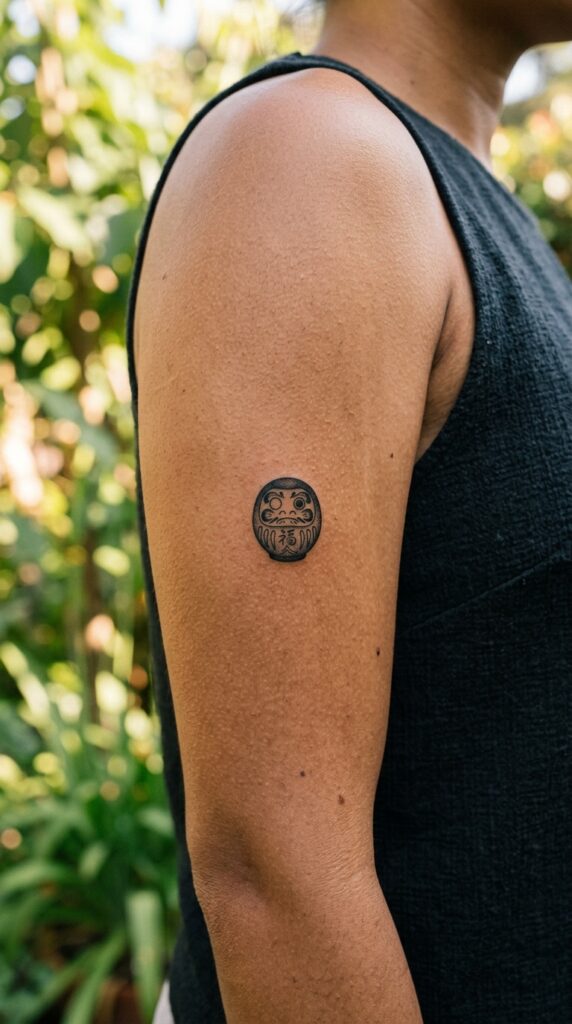
A tiny Daruma doll is round, solid, and immediately charming.
The body is a plump oval, slightly wider at the bottom. The face has large blank circular eyes, a simple mustache, and minimal but precise detailing. The robe wraps the body in a few clean linework patterns.
At micro scale, the Daruma looks like a little character full of personality.
It has a presence that is warm rather than serious.
Daruma dolls come from Japanese folk art and are deeply connected to goal-setting. When you set a goal, you fill in one eye. When you achieve it, you fill in the other.
The Daruma also has a physical quality that makes it iconic: it always rights itself when knocked over. The saying that goes with it is nana korobi ya oki — fall seven times, get up eight.
That phrase is one of the most beloved in Japanese culture.
A tiny Daruma tattoo carries that spirit directly. Get knocked down. Get back up. Keep going.
It is a meaningful tattoo for anyone who has faced setbacks, who is chasing a big goal, or who simply needs that visual reminder that resilience is not optional.
The style of this tattoo also lends itself to a slightly bolder line compared to some of the more delicate entries on this list. The round forms hold up beautifully at micro scale.
On the upper arm or behind the ear, it is a quiet but powerful companion.
13. Japanese Maple Leaf
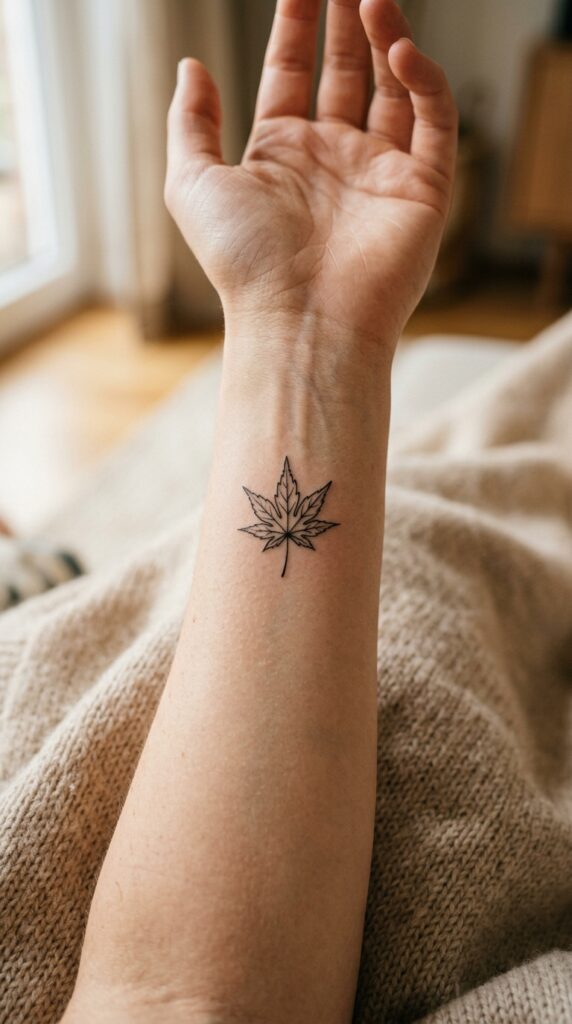
A Japanese maple leaf has one of the most beautiful silhouettes in nature.
The five deeply cut lobes extend from a central point, each lobe tapering to a sharp tip. Fine veins branch through each lobe from the stem. At a small scale in fine line, the leaf looks like a pressed botanical specimen.
It is intricate without being complicated.
In Japan, the momiji, or Japanese maple, is celebrated for its autumn color the same way cherry blossoms are celebrated in spring.
Momiji-gari, meaning maple leaf viewing, is a centuries-old tradition. People go to the mountains and forests to see the leaves turn red, orange, and gold.
The maple leaf is a symbol of the season. Of change. Of things reaching their peak brightness right before they let go.
For people who feel connected to autumn, to transitions, to the idea that endings can be beautiful, the Japanese maple leaf hits differently than other botanical tattoos.
It is also simply one of the most satisfying shapes in nature to render in fine line. The geometry of the lobes and the branching veins give the artist real material to work with at tiny scale.
In black ink, without any color, the leaf reads as elegant and organic.
A single leaf on the inner forearm is a timeless placement. You can also add a small stem curving slightly, as if the leaf is mid-fall, which adds movement and life to the design.
- Best Placement: Inner forearm, 2.5 cm tall | Back of hand, 2 cm wide
- Inspiration: Letting go while looking your most beautiful.
12. Shuriken (Throwing Star)
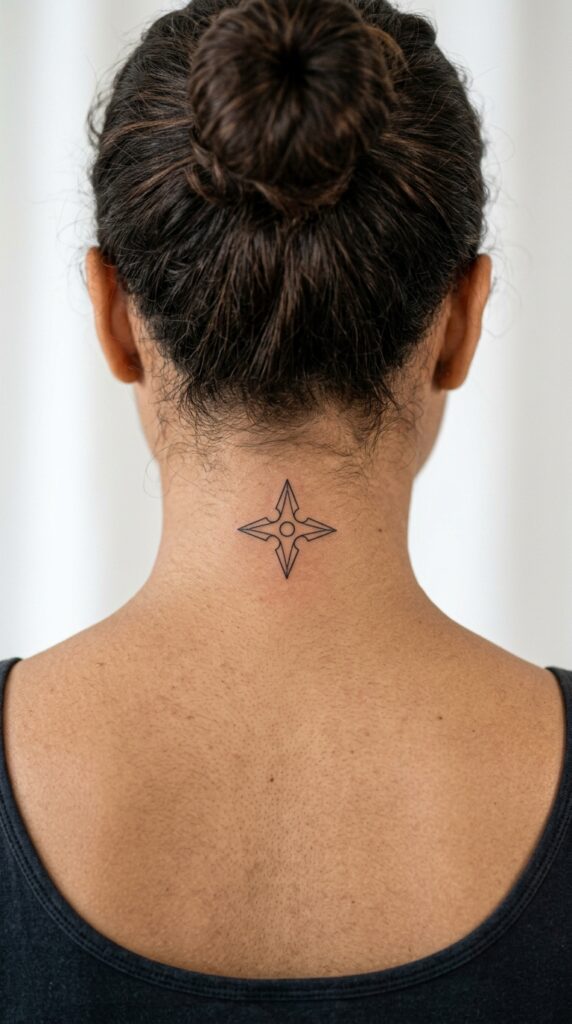
A tiny four-pointed shuriken at the base of the neck. Sharp, geometric, perfectly symmetrical.
Four points radiate outward from a small circle at the center. The edges are clean and precise. No fill, just the outline and the geometry.
At about 1.5 cm wide, it looks deliberate and sharp — like something placed there with intention.
The shuriken is a traditional Japanese concealed weapon used by shinobi, more commonly known as ninja. The word means hidden hand blade.
In modern culture, the shuriken has become a symbol of focus, precision, and speed. Of someone who moves and acts with intent.
Getting a tiny shuriken tattoo has an edge to it. It is a subtle nod to Japanese warrior culture without being loud or aggressive about it.
People who appreciate Japanese history, martial arts, or the philosophy of the ninja — patience, stealth, strategy — often feel a strong pull toward this design.
It is also just visually excellent. The geometric symmetry of a throwing star reads beautifully at micro scale.
The back of the neck is a particularly strong placement. When your hair is down, it is hidden. When it is up, the star appears suddenly at the nape of the neck, small and precise.
It also works on the inner wrist or the side of the hand.
This is one of those tiny Japanese tattoos where the simplicity of the shape is what makes it powerful. Less detail. More impact.
- Best Placement: Base of neck, 1.5 cm wide | Inner wrist, 1.5 cm wide
- Inspiration: Precise, focused, and always ready.
11. Dragon (Micro Outline)
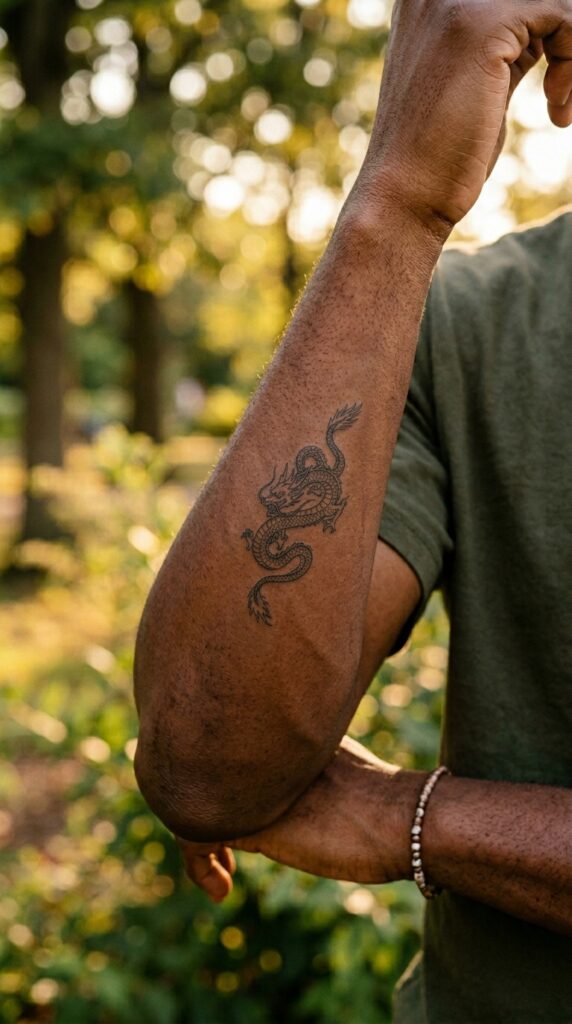
A micro Japanese dragon coils diagonally across the forearm in outline only.
The serpentine body curves once, giving it a sense of movement. Small horns sit above a fierce, compact face. Whiskers trail back from the snout. Clawed feet grip the air. The whole creature is rendered in pure linework with no shading or fill.
At this small scale, it is a feat of precision.
But when the artist is skilled, the dragon looks alive.
Japanese dragons are nothing like Western ones. They do not breathe fire and hoard gold. They are water creatures, associated with rain, rivers, and the sea. They are protectors, not destroyers.
In Japanese mythology, the dragon is a symbol of wisdom, strength, and good fortune. It is one of the most revered creatures in the entire cultural tradition.
A tiny dragon tattoo carries that weight quietly. A small guardian on the skin.
People who resonate with themes of protection, wisdom, and personal power often feel a pull toward dragon imagery. The Japanese style in particular has a fluidity and elegance that sets it apart.
In micro fine line, the dragon works best as a silhouette or near-silhouette. Too much interior detail at this size becomes muddy. The outline approach keeps it readable and impressive.
On the outer forearm, the diagonal orientation gives the dragon visual direction and energy. It looks like it is moving through your arm.
- Best Placement: Outer forearm, 5–6 cm diagonal | Upper back center, 4 cm tall
- Inspiration: A quiet guardian with real power behind it.
10. Moon and Cloud
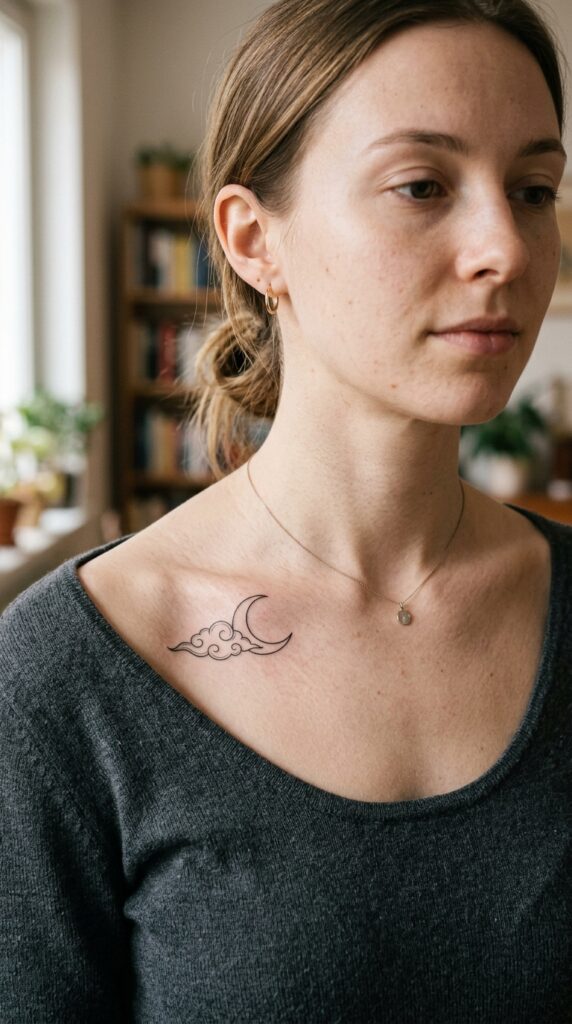
A crescent moon sits above two small traditional Japanese clouds, and the whole image feels like a night sky pulled into your skin.
The moon is a clean crescent, slightly curved. The clouds are the classic rounded, puffy Japanese style — layered outlines stacked in soft peaks.
In fine line black, the composition is light and dreamy without feeling childish.
Everything about it feels calm.
The moon has deep significance across Japanese culture. It is associated with beauty, reflection, and impermanence. The Japanese tradition of tsukimi, or moon viewing, is one of the most beloved seasonal rituals.
Traditional Japanese clouds, called kumo, appear throughout historical art and have their own stylized language. They soften the sky around deities, warriors, and natural scenes in woodblock prints.
Together, the moon and cloud create an image that feels ancient and poetic.
People get this tattoo because it is beautiful in the way that something quiet and unhurried is beautiful. There is no urgency in this image. Just the sky doing what it does.
It is also a design that invites personalization. You can add a single star, a tiny mountain peak below, or a falling blossom drifting past the moon.
Or keep it exactly as it is: small, still, and lovely.
The collarbone is perfect for this composition. Horizontal and delicate, it follows the natural curve of the bone.
- Best Placement: Collarbone, 3–4 cm wide | Inner forearm, 3 cm tall
- Inspiration: Beauty in stillness and the passing of time.
9. Samurai Helmet (Mini)
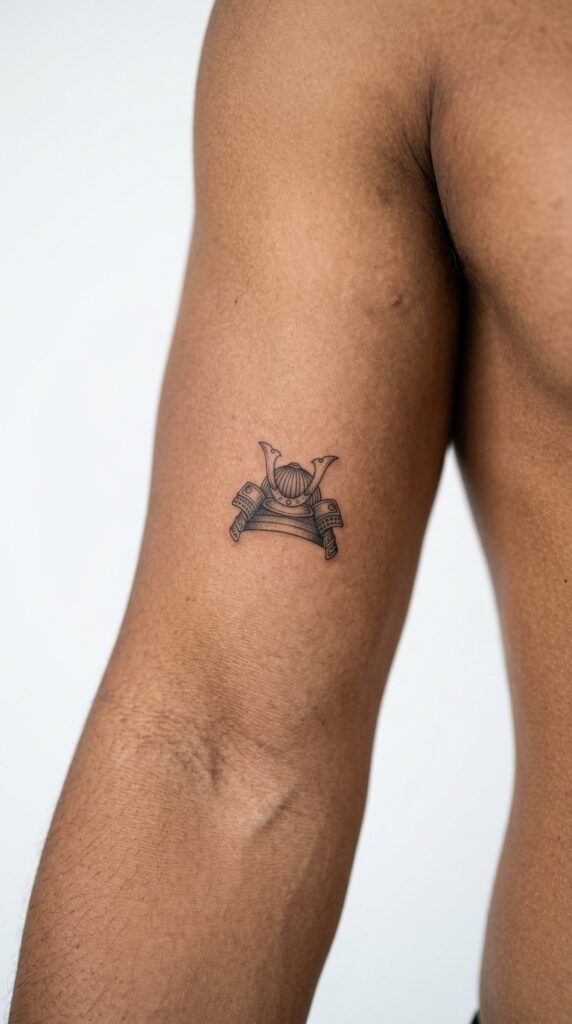
A tiny kabuto samurai helmet is compact and loaded with detail.
The dome curves at the top with a central ridge running down the middle. Side flaps hang down to protect the neck. A small horn or decorative crest sits at the front.
At micro scale, the linework packs a lot of architectural detail into a small space. The helmet has a structural, almost geometric quality that reads clearly even when small.
It looks sharp and commanding.
The kabuto is one of the most iconic objects in Japanese warrior culture. Samurai helmets were not just protective gear. They were works of art, often elaborately decorated to reflect the warrior’s identity and status.
The samurai lived by Bushido, a code of ethics built around loyalty, honor, discipline, and courage. The kabuto represents that entire tradition.
People get this tattoo as a symbol of the warrior mindset. Discipline. Commitment. Facing difficulty with your head up.
It also has a strong visual heritage in Japanese ukiyo-e art and woodblock prints, where helmets appear in dramatic battle scenes alongside flowing banners and warriors mid-charge.
In miniature, all of that history lives on the skin in a surprisingly small space.
The inner upper arm is a great spot because it is visible when you want it to be and hidden in everyday contexts. You can flash it intentionally or keep it private.
It also works on the outer calf or behind the ear at a smaller scale.
- Best Placement: Inner upper arm, 3 cm tall | Outer calf, 3 cm tall
- Inspiration: The warrior code, carried quietly.
8. Japanese Lantern
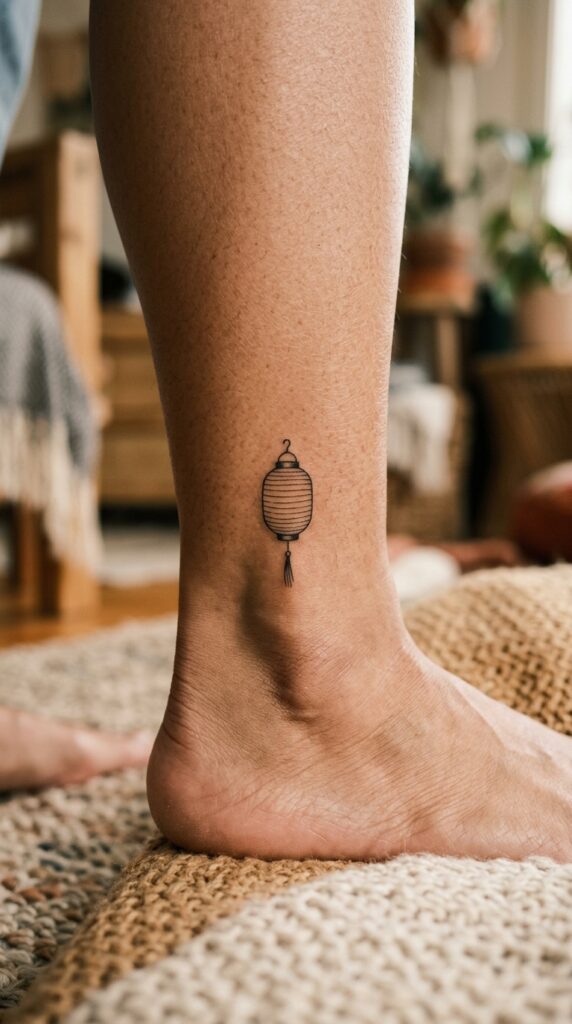
A tiny Japanese paper lantern hangs on the ankle like a little glowing beacon.
The oval body has fine ribbed lines running around its circumference, suggesting the folded paper structure. A small cap sits on top with a hook. A tassel drops from the bottom, giving it a gentle sense of weight and movement.
In fine line black, it looks delicate and crafted, like a real lantern shrunk down to jewelry scale.
It is one of the most charming tiny Japanese tattoos on this list.
Paper lanterns, called chochin in Japanese, light the way during festivals, ceremonies, and rituals. They hang outside temples and restaurants, line the paths of summer festivals, and float on water during Obon, the ceremony honoring ancestors.
The lantern is a symbol of guidance. Of light in the dark. Of warmth that draws people together.
People who are drawn to this design often connect it to memory. To someone who guided them. To a place that felt like home. To the warmth of belonging somewhere.
It also has a quality of celebration. Lanterns appear during the happiest and most sacred moments of Japanese life.
Getting a tiny lantern tattoo is a way of carrying that warmth with you.
On the ankle it sways gently in the imagination, as if hung there by an invisible string.
You can add the thinnest possible line above the hook to suggest a cord, which reinforces the hanging quality beautifully.
- Best Placement: Outer ankle, 2.5 cm tall | Inner wrist, 2 cm tall
- Inspiration: A light that guides, warms, and remembers.
7. Kanji Character
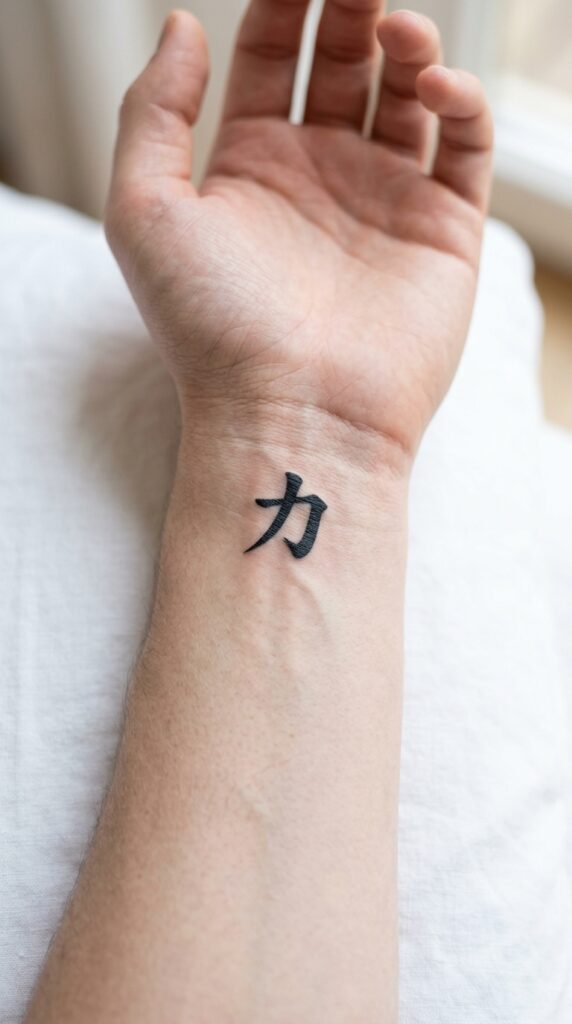
A single kanji character on the inner wrist is minimal, direct, and deeply personal.
The character is rendered in brush script style, with strokes that vary in weight. Thick where the brush pressed down. Thin where it lifted. The same energy you see in traditional Japanese calligraphy.
Even at 1.5 cm tall, the brushwork quality comes through.
It has a quiet confidence that no other tattoo style quite matches.
Kanji are the logographic characters used in written Japanese, borrowed from Chinese script. Each one carries a meaning or concept in a single symbol.
Popular choices include 強 (strength), 愛 (love), 和 (harmony), 夢 (dream), and 心 (heart). But the right kanji is the one that means something specific to you.
Before getting any kanji tattoo, it is worth spending real time on research. Make sure the character is correct, and make sure it says exactly what you intend.
Finding a native Japanese speaker or calligrapher to review or design the character adds authenticity and accuracy.
When the kanji is right, it is one of the most powerful tiny tattoos you can get. A single symbol that holds an entire concept.
On the inner wrist, you see it every time you glance down. It becomes part of how you move through the day.
Some people pair two kanji side by side for a small phrase. That version works beautifully on the inner forearm where there is a bit more room.
- Best Placement: Inner wrist, 1.5 cm tall | Inner forearm, 2 cm tall
- Inspiration: One word. One concept. Everything you need.
6. Japanese Fox (Kitsune)
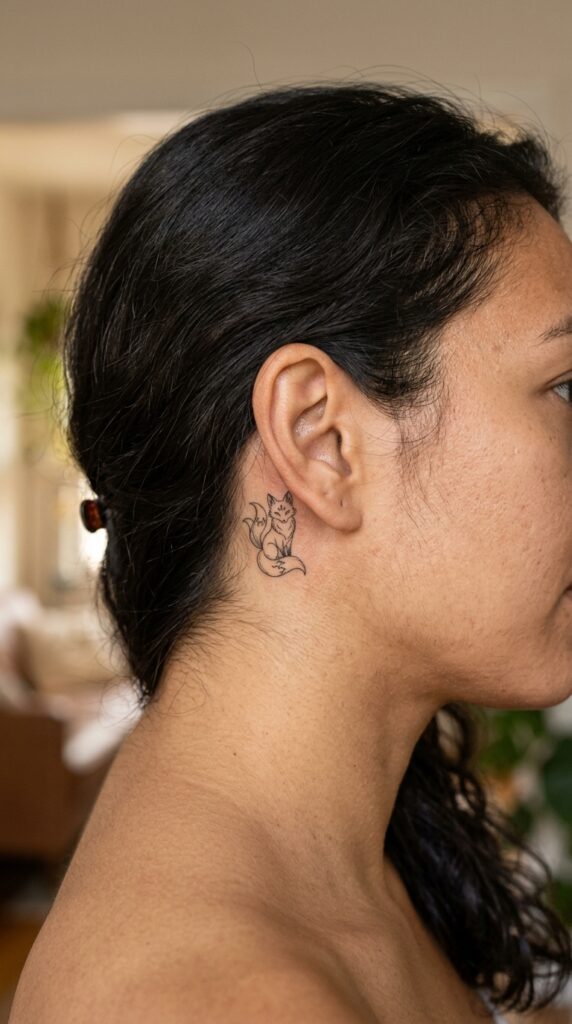
A tiny kitsune fox peeks out from behind the ear, pointed ears alert, eyes bright and knowing.
The design can be a full seated fox or just the face. Either way, the ears are sharp, the snout is elegant, and one or two tails curl behind the figure.
In micro fine line, every feature is precise. The eyes have a quality to them. Like the fox is watching.
It is mysterious and beautiful and a little otherworldly.
In Japanese mythology, the kitsune is a magical fox spirit. As foxes age, they gain wisdom and extra tails — the most powerful kitsune can have nine.
The kitsune is a shapeshifter, trickster, and messenger of Inari, the Shinto deity of foxes, rice, and fertility. It can be a protector or a mischief-maker depending on its mood.
People drawn to the kitsune are often drawn to the idea of intelligence with a playful edge. Cleverness as a superpower. The ability to adapt and transform.
This tattoo is also popular among people who love Japanese folklore and the world of yokai, supernatural beings from Japanese mythology.
Behind the ear is a perfect placement for the kitsune. It feels secretive, which suits the creature perfectly.
A fox that hides in plain sight. Present but not always visible. Sharp but quiet.
If you want more room for tail detail, the inner wrist gives the fox space to stretch out a little.
- Best Placement: Behind the ear, 1.5 cm tall | Inner wrist, 2 cm tall
- Inspiration: Clever, adaptable, and always a step ahead.
5. Sashiko Geometric Pattern
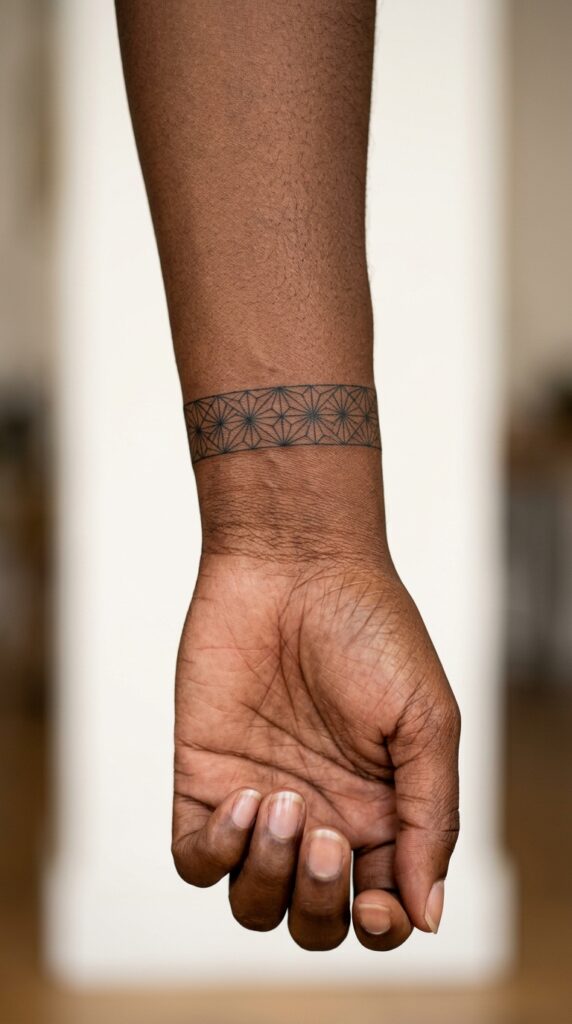
A sashiko geometric pattern wraps the wrist as a narrow band, and it looks like something woven rather than inked.
The design uses repeating interlocking shapes — diamonds, stars, or a grid — rendered in fine, even linework. Each unit connects to the next in a continuous pattern that goes all the way around the wrist.
The precision of it is extraordinary at this scale. Every line has to be consistent. Every angle has to match.
When it is done right, it looks like a cuff of Japanese textile art.
Sashiko is a traditional Japanese form of reinforcement stitching. It was used to strengthen fabric, particularly the clothing of rural workers and fishermen.
The word means little stabs, referring to the short running stitches used in the technique. Over time, the patterns became art in themselves.
The most famous sashiko patterns are based on natural and geometric forms: hemp leaves, woven baskets, ocean waves, and interlocking circles.
These patterns represent strength through repetition. Small actions, consistently applied, creating something whole and beautiful.
A sashiko-inspired tattoo band carries that same energy. Discipline. Craft. The beauty of precision.
It is also one of the most unique tiny Japanese tattoos you can get. Most people recognize Japanese imagery like koi and cranes. Sashiko is known and loved by those who appreciate the deeper layers of Japanese folk art.
- Best Placement: Wrist band, 1 cm tall | Ankle band, 1 cm tall
- Inspiration: Small and steady, building something that holds.
4. Oni Mask (Micro)
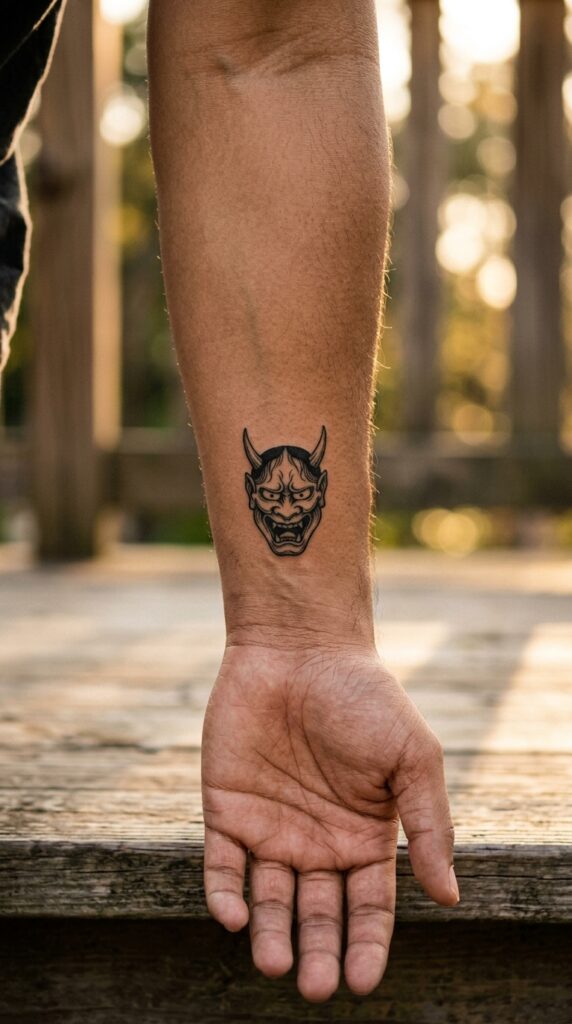
A micro oni mask packs a wild amount of energy into a tiny space.
Wide curving horns extend from the top. Bulging round eyes stare out. A mouth opens wide with visible teeth. Wild brow lines and hair frame the face.
All of it is rendered in dense micro linework that holds together at a size no bigger than a bottle cap.
It is bold, fierce, and surprisingly easy to love at close range.
The oni is a horned demon from Japanese folklore. It is one of the most iconic supernatural beings in all of Japanese mythology, appearing in festivals, art, temples, and modern design.
Oni are often depicted as enforcers of divine justice — punishing the wicked in the afterlife. They are feared and respected at the same time.
In modern tattoo culture, the oni mask has become a symbol of strength, danger, and protection. Of a side of yourself that has teeth. Of facing your own darkness and not flinching.
The oni and the Hannya often appear together, male and female counterparts in a traditional pairing. Getting a micro oni alongside a micro Hannya creates one of the most powerful small tattoo pairings in Japanese tattooing.
On the inner forearm, the oni is visible every time you extend your arm. There is something honest about that placement. You are not hiding what you carry.
For a slightly more private version, the upper inner arm or the side of the ribs keeps it closer to you.
- Best Placement: Inner forearm, 2.5–3 cm tall | Outer upper arm, 3 cm tall
- Inspiration: Strong enough to face your own dark side.
3. Plum Blossom Branch
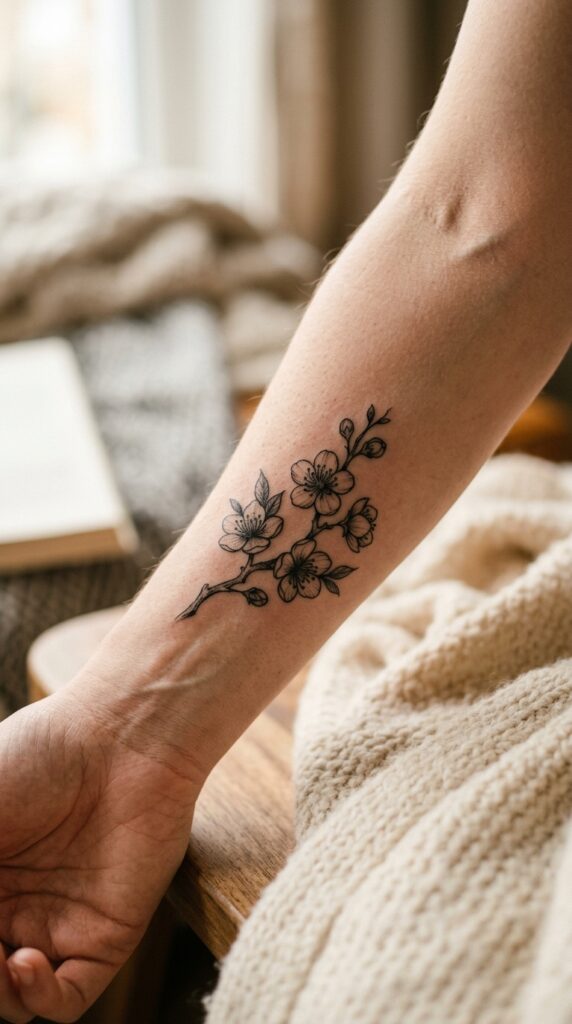
A plum blossom branch curves diagonally across the inner forearm, and it is one of the most quietly beautiful tattoos on this entire list.
The branch is slightly gnarled, textured with fine lines that suggest bark. Three to five blossoms sit along it, each one five-petaled with a small center circle. A few tight buds sit between the open flowers.
The whole composition has a natural, spontaneous quality, like it grew there.
In Japanese culture, the ume, or plum blossom, actually blooms before the cherry blossom. It pushes through in late winter, sometimes through snow.
This is why the plum blossom carries the meaning it does: hope and courage. Strength in difficult conditions. The capacity to bloom before conditions are ideal.
Where cherry blossoms are about the fleeting nature of beauty, plum blossoms are about the stubbornness of beauty. Growing when it is still cold. Refusing to wait.
People who have found their footing through hard seasons often feel deeply connected to this flower.
A branch composition gives the design a sense of life and direction that a single flower does not. The branch suggests continuity. Something rooted that keeps putting out new growth.
In fine line black, the plum branch is one of the most elegant botanical tattoos available in this style.
It ages gracefully, and the natural branch form allows for small additions later — an extra blossom, a tiny bird resting on a twig.
- Best Placement: Inner forearm, 6–7 cm diagonal | Collarbone, 4–5 cm wide
- Inspiration: Blooming before the season says you should.
2. Torii Gate with Moon
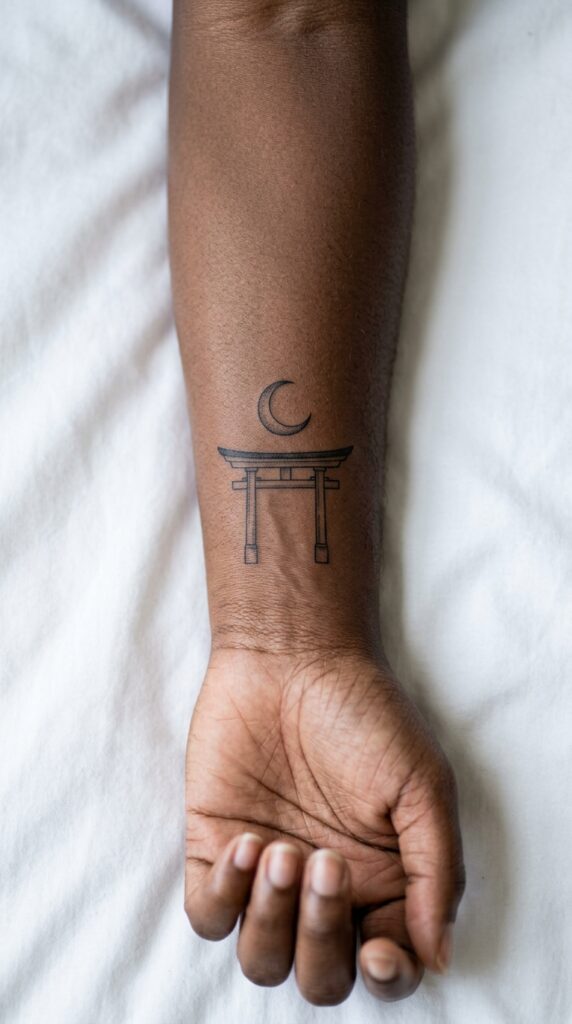
A torii gate stands at the bottom. A moon sits perfectly centered above the crossbar, floating in the space framed by the gate’s uprights.
The composition is vertical, balanced, and instantly striking.
At small scale on the inner forearm, it looks like a scene. A threshold with the moon waiting on the other side.
This is one of those tattoo combinations where two individual symbols become something greater together.
The gate marks the boundary between the ordinary and the sacred. The moon represents beauty, impermanence, and the cycles of time.
Placed together, they create an image that feels like standing at the edge of something. A threshold moment. A view into the spiritual from the human side.
People drawn to this combination often feel a deep connection to Japanese spirituality or Shinto. They might be someone who has spent time at a shrine, or who feels the pull of sacred places and the quiet that lives in them.
This composition also photographs beautifully, which makes it an excellent choice for a visible placement.
The inner forearm gives it a vertical column to live in, and the skin of the forearm is relatively flat, which keeps the fine lines clean and consistent.
You can add the thinnest mountain silhouette behind the gate for a more layered scene. Or keep it stripped down to just the gate and moon.
Either version is complete.
This pairing sits at number two on this list because it is one of the most compositionally satisfying tiny Japanese tattoos you can get. Two symbols. One perfect image.
- Best Placement: Inner forearm, 4–5 cm tall | Sternum, 3.5 cm tall
- Inspiration: Standing at the edge of something sacred.
1. Koi and Lotus
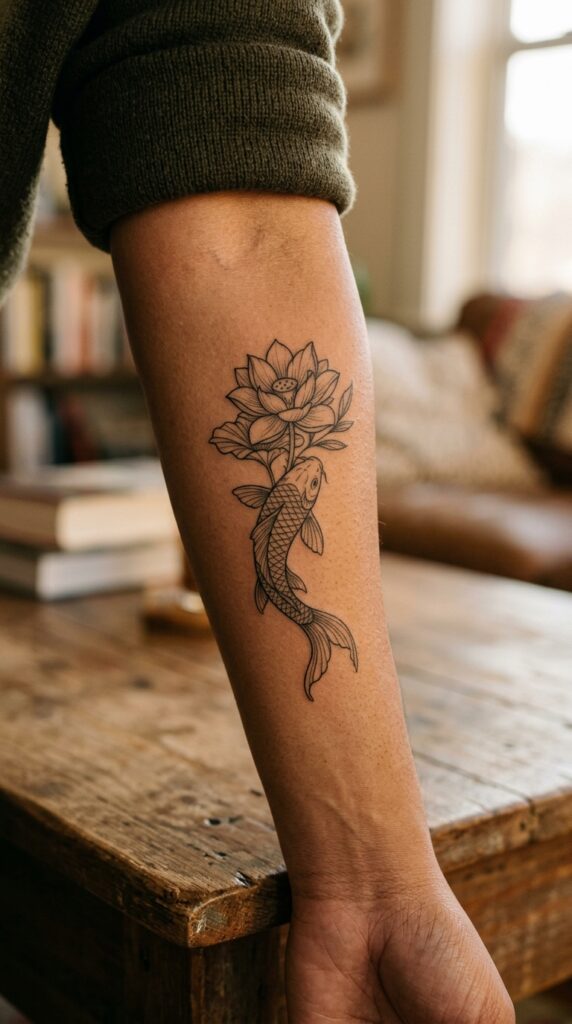
A koi fish rises upward through the water. At the top, a lotus waits in full bloom.
The koi body is curved, its motion clear even without water around it. The lotus above is open, petals layered outward. The two connect in a single vertical composition that tells a complete story.
From struggle to bloom. From the muddy bottom to the surface.
In fine line black, the koi scales are suggested with small curved marks. The lotus petals are clean and symmetric. The whole image is maybe 6 cm tall and packs more meaning per centimeter than almost anything else on this list.
This combination is the most powerful pairing in Japanese tattoo symbolism.
The koi represents perseverance. The lotus represents rising above difficulty. Together, they tell the complete arc: you fought your way up through hard conditions, and you arrived somewhere open and beautiful.
This is not just a pretty tattoo. It is a visual story about a real human experience.
People who have come through something genuinely difficult — illness, loss, rock bottom, a long climb back — often feel that this design says exactly what they could never quite put into words.
At tiny scale, it is intimate. Personal. Not a declaration, but a quiet confirmation.
The inner forearm is the ideal placement because the vertical composition reads naturally there. Every time you look down at your arm, the koi is still climbing and the lotus is still open.
That daily reminder is the whole point.
This is the number one tiny Japanese tattoo because it holds everything. Beauty, struggle, meaning, and a story that feels true.
- Best Placement: Inner forearm, 5–6 cm tall | Sternum, 4 cm tall
- Inspiration: Through the mud and into the light.
Closing
There is no wrong answer when it comes to tiny Japanese tattoos.
Every symbol on this list has centuries of meaning behind it, and the right one is simply the one that speaks to you most.
Take your time, find an artist who specializes in fine line or micro work, and let the design be exactly as personal as it deserves to be.