27 Grief Tattoo Ideas for Losing a Father That Honor Who He Was
You already know what you’re carrying. You don’t need this article to tell you grief is hard – you need it to help you find something that holds it. A tattoo for your father isn’t about moving on. It’s about keeping him close in a way that doesn’t fade when the sympathy cards stop coming.
This list covers 27 meaningful grief tattoo ideas specifically for losing a dad – symbols, portraits, nature imagery, and text-based designs that people have used to mark that loss in a permanent, personal way. Each entry includes the meaning behind it, popular styles, placement suggestions, and who it tends to resonate with most.
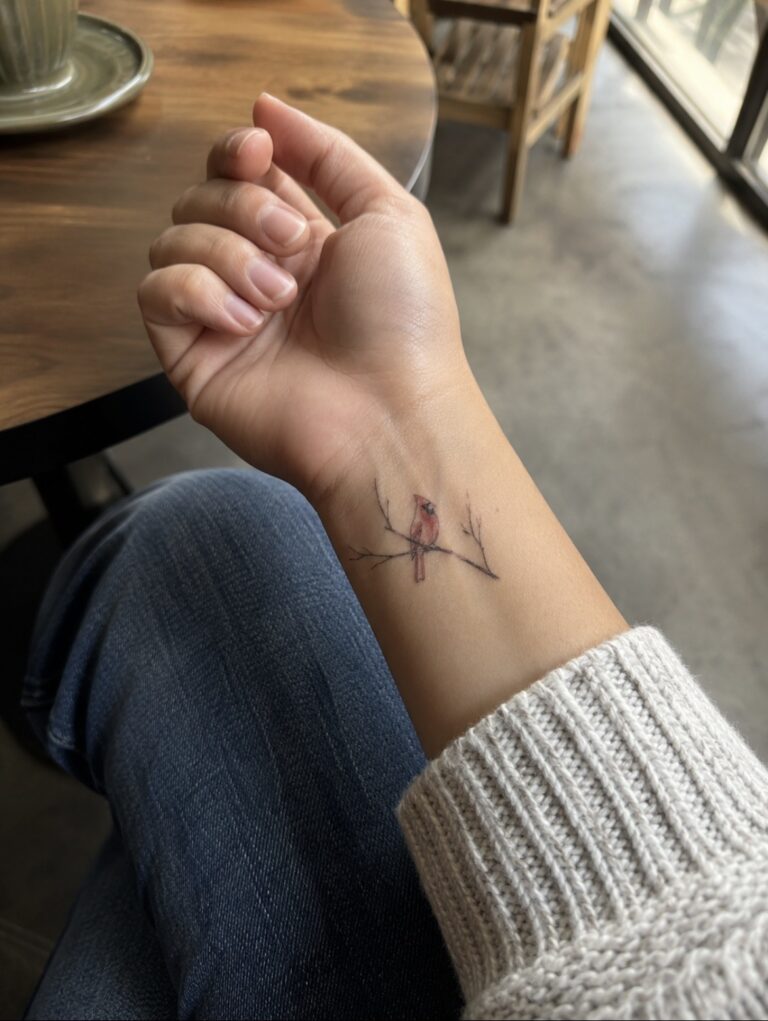
1. Cardinal Bird Tattoo
[IMAGE: a red cardinal bird perched on a bare winter branch, fine line tattoo style, grief memorial]
Meaning: A visit from someone you’ve lost – the belief that cardinals carry the spirits of the dead.
This one carries a belief that runs deep in a lot of families, especially in the South and Midwest: when a cardinal shows up, someone you love is nearby. It’s not a formal religious doctrine – it’s the kind of quiet faith that gets passed between generations. The red against bare branches reads as both loss and presence at the same time, which is why it works so well as a grief tattoo.
Spiritual / Cultural Significance: The cardinal is widely associated in American folk belief with the idea that departed loved ones return as birds to check in on the living. Native American traditions also link the cardinal to vitality and the continuation of energy beyond death. For many people, it becomes a symbol of that specific moment – the first time a cardinal appeared after the funeral and they felt something shift.
Popular Styles:
- Fine line with red ink accent
- Realistic watercolor
- Blackwork silhouette
- Simple minimalist outline
- Neo-traditional with bold red fill
Best Placement:
- Inner wrist
- Collarbone
- Behind the ear
- Shoulder blade
- Forearm
Why People Choose It: A lot of people get this one after a specific moment – a cardinal landed outside on a rough day and it felt like something. That experience is hard to explain and easy to dismiss, which is exactly why it helps to have it marked somewhere permanent.
Best For: Someone who had a moment after the loss that they can’t explain but can’t forget.
2. Empty Chair Tattoo
[IMAGE: a single empty wooden chair rendered in fine line black ink, memorial tattoo concept]
Meaning: The space a person leaves behind – presence defined by absence.
What makes this image hit so hard is what it doesn’t show. There’s no person, no action, no movement – just the chair. And that’s exactly what grief feels like in a house: the chair at the table, the recliner in the corner, the passenger seat that nobody takes. It’s one of the most honest tattoo concepts for losing a parent because it doesn’t try to soften anything.
Spiritual / Cultural Significance: The empty chair has been used as a grief symbol across cultures and contexts – from the ceremonial chair left for the deceased in certain Jewish mourning traditions to the broader cultural shorthand of an empty seat meaning loss. It’s also a design that doesn’t require any cultural or religious framework. The meaning is universal and immediate.
Popular Styles:
- Fine line single needle
- Minimalist geometric
- Sketch or illustrative style
- Blackwork with shadow detail
- Realistic engraving style
Best Placement:
- Inner forearm
- Upper arm
- Ribcage
- Back of the calf
- Sternum
Why People Choose It: It’s chosen by people who don’t want comfort imagery – who want the tattoo to be honest about the shape of the hole. There’s a kind of dignity in that choice. It says: this loss is real and I’m not going to cover it up with wings.
Best For: Someone who wants their tattoo to sit with the grief rather than resolve it.
3. Compass Rose Tattoo
[IMAGE: detailed compass rose tattoo in fine line style with cardinal directions, memorial grief design]
Meaning: A father was your direction – now you carry that navigation in yourself.
The compass doesn’t just stand for travel. It stands for orientation – knowing where you are relative to everything else. Fathers carry that function for a lot of people without either side naming it out loud. He was the person you called when you were lost, literally or otherwise. Getting a compass after losing him is a way of saying: I have to find that direction inside myself now. It’s a hard truth that also carries something hopeful.
Spiritual / Cultural Significance: The compass rose has roots in navigation and cartography going back centuries, but its symbolic meaning has expanded to represent personal guidance, true north, and moral orientation. In grief contexts, it’s often connected to the idea of finding your way through loss – not past it, but through it. Some people add coordinates (birthplace, hometown, place of death) to anchor the image to a specific life.
Popular Styles:
- Fine line with geometric detail
- Blackwork with mandala elements
- Nautical traditional style
- Watercolor wash background
- Minimalist four-point version
Best Placement:
- Chest
- Inner forearm
- Upper back between shoulders
- Thigh
- Shoulder
Why People Choose It: Often chosen by people who leaned on their father for decisions, stability, or perspective – and are now learning to trust their own. It honors what he gave them without pretending they don’t feel the absence.
Best For: Someone who is still figuring out how to be the person their dad believed they were.
4. Father and Child Silhouette Tattoo
[IMAGE: silhouette of a father lifting a small child into the air, minimalist black ink tattoo design]
Meaning: The bond between father and child – a moment that existed and still does.
This is about memory over symbol. Not what a father means in the abstract, but what yours actually did – the way he lifted you as a kid, the shape of his hands, the way you felt completely safe in a way you didn’t know would end. A silhouette strips the image down to its emotional core. You don’t need the face. The gesture is enough.
Spiritual / Cultural Significance: Silhouette imagery in memorial tattoos traces back to the idea that a shadow preserves the form without requiring detail – it’s presence without fully showing what’s gone. The parent-child silhouette specifically has become one of the most recognizable grief tattoo concepts of the last decade, adaptable to any memory or moment from a shared life.
Popular Styles:
- Pure black silhouette, no detail
- Silhouette with fine line sky or landscape
- Watercolor behind the silhouette
- Integrated with a meaningful date
- Minimalist single-needle outline
Best Placement:
- Upper arm
- Thigh
- Back
- Forearm
- Ribcage
Why People Choose It: People choose this when there’s a specific memory they keep returning to – not a concept, but an actual moment. The tattoo becomes a way of keeping that moment preserved somewhere it can’t be reached by time or forgetting.
Best For: Someone who has one memory of their dad they never want to stop being able to picture clearly.
5. Oak Tree Tattoo
[IMAGE: detailed oak tree with full canopy and deep roots in fine line black ink, memorial tattoo]
Meaning: Strength that sheltered you – roots that don’t disappear when the tree does.
An oak is not a quiet tree. It’s wide, it’s heavy, it takes a long time to grow and a long time to fall. That’s the point. Fathers who feel like oaks – who held the family steady through things that should have broken it – often get this as their tribute. The roots matter as much as the canopy here. What he gave you didn’t die when he did.
Spiritual / Cultural Significance: The oak has been sacred across Celtic, Norse, and Greek traditions – associated with Zeus, Thor, and the Druids’ most revered tree. In each context it carries the same core meaning: endurance, power, and protection. Its roots growing as deep as its branches grow tall is a design detail that matters symbolically – it represents legacy going in both directions through time.
Popular Styles:
- Detailed fine line with visible roots
- Blackwork with heavy contrast
- Watercolor seasons concept
- Minimalist bare branches
- Realistic botanical illustration
Best Placement:
- Full back or spine
- Thigh (roots to knee)
- Outer upper arm
- Ribcage
- Forearm (vertical orientation)
Why People Choose It: This is the tattoo for the dad who was the family’s foundation – the one who kept things together, who didn’t say much but whose presence was the whole structure. It’s a way of saying that structure didn’t collapse when he left. It changed form.
Best For: Someone whose father was the quiet center of gravity in their family.
6. Lighthouse Tattoo
[IMAGE: tall lighthouse on rocky shore with beam of light, fine line memorial tattoo with wave detail]
Meaning: A father who guided you through the dark, even when he wasn’t speaking.
Not every dad expressed himself easily. Some of them showed up through action – by being reliable, by being there, by being the light on in the window when things got bad. The lighthouse doesn’t call out to you. It just stays lit. That’s the feeling this tattoo holds: a presence that guided you without making a fuss about it.
Spiritual / Cultural Significance: Lighthouses carry a specific emotional resonance in maritime cultures as beacons of safety and return. Symbolically, they represent clarity in confusion, steadiness in chaos, and the assurance that someone is watching for you. In a grief context, the light is often the detail that makes the image feel like a specific person rather than a generic symbol.
Popular Styles:
- Fine line with ocean and horizon
- Geometric lighthouse with linework waves
- Watercolor atmospheric version
- Blackwork with stipple texture
- Traditional bold outline
Best Placement:
- Forearm
- Shin
- Upper arm
- Shoulder blade
- Calf
Why People Choose It: It tends to resonate for people whose fathers weren’t expressive but were always, without exception, there. The kind of dad who didn’t say “I love you” easily but answered every call and showed up every time.
Best For: Someone whose dad showed love through reliability rather than words.
7. Pocket Watch Tattoo
[IMAGE: open vintage pocket watch showing a specific time, fine line memorial tattoo with chain detail]
Meaning: Time stopped at the moment of loss – a life marked by its specific hours.
Stop the hands at a time that matters. The moment of his birth, the time he passed, the hour of a phone call you’ll never forget. A pocket watch frozen in time is one of the most direct statements a grief tattoo can make – it doesn’t try to soften or symbolize. It says: this moment happened, and I am keeping it.
Spiritual / Cultural Significance: The stopped clock as a grief symbol appears across literature, film, and Victorian mourning tradition – where clocks were literally stopped in the house of the dead. The pocket watch specifically carries masculine connotations, often passed between generations, which makes it particularly resonant as a tribute to a father figure. If he actually owned one, the design can reference the real object.
Popular Styles:
- Realistic black and grey with chain
- Fine line open-faced with filigree
- Geometric face with Roman numerals
- Neo-traditional with bold outline
- Minimalist clock face only, no casing
Best Placement:
- Upper arm or shoulder
- Thigh
- Chest
- Forearm
- Calf
Why People Choose It: People choose this when there’s a specific time they can’t stop returning to. It’s a way of honoring the weight of that moment without having to explain it to anyone who asks.
Best For: Someone who wants to mark a specific time that changed everything, without having to say which one out loud.
8. His Handwriting Tattoo
[IMAGE: flowing cursive handwriting tattoo of a short phrase or signature in black ink on inner forearm]
Meaning: His actual voice, made permanent – something only he could have written.
There is no symbol more specific than his handwriting. Not a concept, not an approximation – his. A signature from an old birthday card, a note in a recipe book, a text message screenshot, the last thing he ever wrote to you. Whatever it is, if you have it, it is irreplaceable. This tattoo is for people who want something that could never have belonged to anyone else’s father.
Spiritual / Cultural Significance: Handwriting has long been understood as a physical extension of personality – the pressure, the slant, the loops all carry something of the person. In Jewish and Islamic traditions, written words carry sacred weight beyond their content. As a memorial practice, tattooing a loved one’s handwriting is increasingly common precisely because it preserves something no artist could reproduce from scratch.
Popular Styles:
- Exact replica of original writing, no stylization
- Slight size adjustment only – keep all character of the original
- Single word or short phrase
- Full signature
- A date written in his hand
Best Placement:
- Inner wrist
- Inner forearm
- Collarbone
- Behind the ear (for very short text)
- Ribcage
Why People Choose It: Because everything else fades – the voice recordings get harder to find, the voicemails get deleted by accident, the memory of how he sounded blurs at the edges. His handwriting doesn’t change. This is about preserving something that is uniquely, specifically him.
Best For: Someone who found a card, a note, or a letter and can’t bring themselves to put it away.
9. Semicolon with Memorial Date Tattoo
[IMAGE: semicolon symbol integrated with a memorial date in fine line script, grief tattoo concept]
Meaning: The story continues – a pause, not an ending.
The semicolon on its own carries the meaning of continuation – a sentence that could have ended but didn’t. When it’s paired with a date, it does two things at once: it marks the moment of loss and it makes a statement about the living. This design is for the person who has had to work to keep going after their father died. The date is where the sentence almost ended. The semicolon is everything after.
Spiritual / Cultural Significance: The semicolon as a mental health and suicide awareness symbol became widely known through Project Semicolon, founded in 2013. In grief contexts it has been adopted more broadly to represent survival after profound loss – the choice to continue. Pairing it with a specific date grounds the abstract symbol in personal history and makes it uniquely theirs.
Popular Styles:
- Fine line semicolon with script date
- Minimalist single needle
- Integrated into a small meaningful image (butterfly, flower)
- Bold blackwork symbol with light script
- Semicolon as part of a longer sentence tattoo
Best Placement:
- Inner wrist
- Behind the ear
- Finger (for very minimal version)
- Collarbone
- Inner forearm
Why People Choose It: People choose this at a turning point – often months or years after the loss, when they have processed enough to say: I’m still here and that matters. It’s a quiet form of self-recognition.
Best For: Someone who went through a dark period after losing their dad and came out the other side wanting to mark that survival.
10. Anchor Tattoo
[IMAGE: classic anchor tattoo with rope detail in fine line black ink, memorial grief design for father]
Meaning: He kept you grounded – he was the thing that held when everything else moved.
An anchor doesn’t glamorize. It doesn’t rise or soar – it holds. Fathers who functioned as emotional anchors for their families get this as their tribute because the metaphor is almost too accurate. He was the reason things didn’t drift. Now there’s a different kind of holding required, and the tattoo becomes a reminder that what he gave you still works inside you even when he isn’t there to hold you in place himself.
Spiritual / Cultural Significance: The anchor is one of the oldest Christian symbols, representing hope and steadfast faith – found in the catacombs as an early code for the cross. In maritime culture, it signifies safe return, stability at sea, and the weight that prevents loss. As a grief symbol, it’s most often chosen for fathers who were the emotional bedrock of the family.
Popular Styles:
- Traditional sailor anchor with rope
- Fine line minimalist anchor
- Anchor with integrated name or date
- Geometric anchor with linework
- Blackwork with heavy shadow
Best Placement:
- Forearm
- Wrist
- Shoulder
- Ankle
- Chest
Why People Choose It: It tends to come from people who felt their world become genuinely unstable after the loss – who are looking for something that says: there is still weight here, there is still ground.
Best For: Someone who hasn’t felt steady since their dad died and is tattooing something that promises steadiness back.
11. Flying Birds (Flock) Tattoo
[IMAGE: flock of birds in flight silhouette forming an upward arc, fine line minimalist memorial tattoo]
Meaning: A spirit in motion – freedom from the body, continuation beyond it.
Birds leaving a frame. There’s something about the movement of it – the direction, the rising, the openness – that fits the feeling of loss better than a static image sometimes can. A flock rather than a single bird carries more weight here: it suggests multitude, belonging, the idea that he joined something rather than simply disappeared. The design grows naturally into something the body carries lightly, which matters.
Spiritual / Cultural Significance: Birds as soul-carriers appear across cultures – in ancient Egypt, the ba (part of the soul) was depicted as a human-headed bird. Celtic tradition saw birds as messengers between worlds. In Christian iconography, doves represent the spirit’s departure and peace. A flock dispersing upward is widely read as ascent and release.
Popular Styles:
- Minimalist silhouette flock with varying sizes
- Single line dissolving into birds
- Watercolor with ink silhouettes
- Fine line detailed birds in formation
- Abstract transition from solid form to scattered birds
Best Placement:
- Collarbone to shoulder
- Wrist and forearm
- Behind the ear (small version)
- Shoulder blade
- Ribcage
Why People Choose It: It’s chosen by people who find comfort in the idea of transition over ending – who want their tattoo to hold movement rather than stillness. It’s an image that doesn’t feel like a grave. It feels like a doorway.
Best For: Someone who believes their dad is somewhere, not nowhere.
12. Mountain Range Tattoo
[IMAGE: simple mountain range silhouette in fine line black ink, minimalist memorial tattoo concept]
Meaning: Immovable strength – something vast that shaped the landscape of your life.
Mountains don’t move. That’s the whole point. A father who felt like a mountain – who you couldn’t imagine the horizon without – gets this as his tribute. The range rather than a single peak is important: it suggests complexity, depth, the way someone that significant takes up more than one shape in your memory. There’s no sunrise required, no inspirational text. The mountain range can stand alone and mean everything.
Spiritual / Cultural Significance: Mountains appear across virtually every spiritual and cultural tradition as symbols of the eternal, the divine, and the immovable. In Shinto, Buddhist, and Celtic traditions, mountains are the places where the physical and spiritual worlds connect. As a memorial symbol, a mountain range represents a father who felt eternal – who you couldn’t imagine not existing.
Popular Styles:
- Geometric mountain range with linework
- Minimalist silhouette single line
- Fine line with forest at the base
- Watercolor wash sky with ink mountains
- Dotwork stipple technique
Best Placement:
- Forearm (horizontal band)
- Collarbone
- Upper back
- Shin
- Behind the ear (minimal version)
Why People Choose It: For the person whose father felt permanent – not in a sentimental way but in a structural way – and who is still adjusting to a world where the largest landmark is gone.
Best For: Someone who can’t stop thinking: I didn’t know a person could take up that much space.
13. Cross with Name Tattoo
[IMAGE: simple Latin cross with a name in script below or integrated within, fine line memorial tattoo]
Meaning: Faith and love together – his name held inside the symbol of your belief.
This one doesn’t need explaining to the people who need it. If faith was part of who your father was, or part of what’s keeping you upright right now, putting his name inside a cross is not a cliche – it’s a declaration. The cross holds the name. The name makes the cross personal. That combination is the whole point.
Spiritual / Cultural Significance: The Latin cross is the central symbol of Christianity, representing sacrifice, resurrection, and the promise of life beyond death. In Catholic and Orthodox traditions in particular, memorial tattoos with crosses are a common devotional practice – a way of committing someone’s soul to God’s care visually and permanently. The name is not decoration here. It’s a prayer.
Popular Styles:
- Simple Latin cross with name below in script
- Ornate cross with rosary beads
- Wooden cross in fine line with shadow
- Celtic cross with knotwork
- Cross integrated with angel wings
Best Placement:
- Upper arm
- Chest (over the heart)
- Upper back
- Forearm
- Shoulder
Why People Choose It: It comes from a place where grief and faith are tangled together – where the loss has pushed someone closer to belief or tested it or both at the same time. The tattoo is a way of holding both without resolving the tension.
Best For: Someone whose faith and grief are in conversation with each other and they need somewhere to put that.
14. Infinity Knot Tattoo
[IMAGE: infinity symbol rendered as a continuous knotwork design with a name or date integrated, fine line tattoo]
Meaning: Love that doesn’t end when a life does – the bond that continues past death.
The infinity symbol is used in a lot of contexts, but in a grief tattoo it’s doing something specific: it’s making a claim. It’s saying the relationship isn’t over, that what existed between you and your father doesn’t disappear because he did. When it’s rendered as a true Celtic or decorative knot – no beginning, no end, no broken line – that claim becomes visual as well as symbolic.
Spiritual / Cultural Significance: The infinity symbol has roots in mathematics but its adoption in Celtic knotwork predates the modern symbol – the endless knot in Celtic tradition represents the eternal interconnectedness of life, death, and love. In Tibetan Buddhism, the endless knot is one of the eight auspicious symbols, representing the interdependence of all phenomena. As a grief tattoo, it’s most often chosen to represent a love that the person believes death cannot reach.
Popular Styles:
- Celtic knotwork in fine line
- Simple infinity symbol with integrated name
- Floral elements growing through the loops
- Infinity with birds releasing from one end
- Geometric with sacred geometry detail
Best Placement:
- Inner wrist
- Collarbone
- Ankle
- Behind the ear
- Forearm
Why People Choose It: For the person who needs to say, in a form they can look at every day: this is not over. The connection wasn’t severed. It changed shape.
Best For: Someone who has trouble with the word “was” when they talk about their dad.
15. Fishing Hook Tattoo
[IMAGE: simple fishing hook with line and optional small fish detail, fine line memorial tattoo for father]
Meaning: The thing you did together – the specific memory of him that lives in a quiet Saturday morning.
Not every grief tattoo needs to be a symbol. Sometimes the most powerful thing is a reference to an ordinary ritual – the thing you did every summer, the thing he taught you, the thing you’d give anything to do one more time. For a lot of people, that thing is fishing. A hook is small, specific, and carries the entire weight of those mornings without trying to be more than it is.
Spiritual / Cultural Significance: Fishing holds deep symbolism in Christian tradition (the disciples as fishermen, the fish as early Christian symbol), in Buddhist teaching (right livelihood, patience, mindfulness), and in Indigenous cultures where fishing is both sustenance and ceremony. But in this context, the hook is less about tradition and more about biography. It’s about a specific person and a specific river and a specific kind of silence that felt like love.
Popular Styles:
- Simple fine line hook with or without bait
- Traditional style with bold outline
- Minimalist single hook, no extras
- Hook with small fish and ripple effect
- Hook integrated with a meaningful date or initials
Best Placement:
- Inner wrist
- Behind the ear
- Finger
- Inner forearm
- Ankle
Why People Choose It: It’s chosen by people who don’t need a grand statement. They need a small, quiet nod to the memory they keep coming back to – the one that feels the most like him, the most like them together.
Best For: Someone whose best memories of their dad are small and specific and don’t need any explaining.
16. Wolf Tattoo
[IMAGE: howling wolf in detailed black and grey realism style, memorial tattoo for father figure grief]
Meaning: Fierce protector, loyal beyond measure – the father who would have done anything for his pack.
The wolf means something different depending on the father. For some, it’s the protectiveness – the way he stood between his family and everything threatening. For others, it’s the loyalty, the pack instinct, the way he never left. The wolf is not a gentle symbol but it’s an honest one. It’s for a dad whose love showed up as strength.
Spiritual / Cultural Significance: In Norse mythology, the wolf carries immense power – Odin’s companions Geri and Freki, the cosmic wolf Fenrir, the wolf as a symbol of both destruction and divine might. In Native American tradition, the wolf is a teacher and protector, representing loyalty to family and fierce guardianship. In both frameworks, the wolf is earned symbolism. You give it to someone whose protection was real.
Popular Styles:
- Realistic black and grey portrait
- Geometric wolf with linework
- Traditional bold outline
- Fine line with watercolor eye detail
- Tribal or Haida style
Best Placement:
- Upper arm or shoulder
- Thigh
- Chest
- Upper back
- Forearm
Why People Choose It: This is for the father whose love came through as fierceness – who didn’t talk about it much but whose kids never once doubted it. The wolf doesn’t need to explain itself either.
Best For: Someone whose dad was the kind of man other people knew not to cross.
17. Crown Tattoo
[IMAGE: simple black crown with fine line detail, memorial tattoo for a father described as king]
Meaning: He was your king – the one who held authority and dignity in your world.
There’s a specific kind of grief that comes from losing someone you genuinely looked up to. Not out of obligation, but because they earned it. A crown as a memorial tattoo is a direct statement of that: he was the kind of man you call king, and you’re not being sentimental about it, you’re being accurate. The simplicity of the image carries more weight than anything elaborate would.
Spiritual / Cultural Significance: Crowns across cultures represent divine authority, earned power, and the weight of responsibility held with grace. In many African American and Caribbean communities in particular, “king” is a title given to fathers who carried their families with dignity through difficult circumstances. The crown as memorial tribute in those contexts carries deep cultural resonance beyond the general symbolic meaning.
Popular Styles:
- Simple blackwork crown, clean lines
- Fine line with jewel detail
- Crown with initials or name integrated
- Traditional bold crown with shading
- Minimalist three-point crown
Best Placement:
- Inner wrist
- Behind the ear
- Finger
- Collarbone
- Inner forearm
Why People Choose It: For the person who wants to say simply: he was the most important man I knew, and I mean that without irony or softening. The crown says it in four lines.
Best For: Someone who called their dad their king and meant it literally.
18. Angel Wings Tattoo
[IMAGE: pair of detailed angel wings in fine line black ink, memorial tattoo for a deceased father]
Meaning: He watches over you now – the faith that love doesn’t stop at death.
Angel wings are one of the most used grief symbols, which means the execution matters enormously. What makes them work is specificity of placement, quality of line, and the intention behind them – not the image alone. When done with care, wings hold a comfort that very few other symbols can match, because they make a direct claim: he is not just gone. He became something that watches over.
Spiritual / Cultural Significance: Angels as guardians and messengers appear in Christianity, Islam, Judaism, and Zoroastrianism. The image of wings specifically represents divine protection, elevation of the soul, and transition between states of existence. The wings without a figure attached – just the wings themselves – suggest that the person has become the angel rather than being carried by one. That distinction matters in how people read it.
Popular Styles:
- Realistic detailed feathers in black and grey
- Fine line symmetrical wing pair
- Single wing with a name
- Wings with a halo and initials
- Wings framing a portrait or image
Best Placement:
- Upper back (full spread)
- Shoulder blades (mirrored)
- Chest
- Forearm (single wing)
- Calf
Why People Choose It: People choose this when they believe – not just hope, but believe – that he is still present in some form. The wings make that belief visible. They wear their faith in him on the outside.
Best For: Someone who talks to their dad still, out loud or not, and believes he hears it.
19. Broken Clock Tattoo
[IMAGE: cracked or shattered clock face stopped at a specific time, detailed black and grey tattoo style]
Meaning: The moment time broke – when the world divided into before and after.
Unlike the intact pocket watch, the broken clock doesn’t try to contain the moment neatly. It cracks it open. It’s for the person who wants to be honest about what death actually did to time – how the day your father died became a wall, and everything since has been measured against it. It’s not about preservation. It’s about marking the rupture.
Spiritual / Cultural Significance: The stopped clock as a symbol of grief and arrested time appears throughout Victorian mourning culture and is famously literalized in literature and art as a way of representing how grief distorts the passage of time. The addition of damage – cracks, shatter lines, broken glass – takes the symbol further, representing not just the moment but the impact of it. Time didn’t just stop. It broke.
Popular Styles:
- Realistic shattered clock face in black and grey
- Cracked clock with flowers growing through the breaks
- Fine line minimalist crack detail
- Neo-traditional with bold damage lines
- Clock face dissolving into birds or smoke
Best Placement:
- Upper arm or forearm
- Thigh
- Chest
- Upper back
- Ribcage
Why People Choose It: It’s for the person in the thick of it – who doesn’t have the distance yet to talk about what happened with anything other than honesty. The broken clock doesn’t pretend.
Best For: Someone who is still in the part of grief where they can’t believe the world kept moving.
20. Memorial Portrait Tattoo
[IMAGE: realistic portrait tattoo of an older man in black and grey, high detail memorial style]
Meaning: His face, kept – a refusal to let the memory of how he looked fade.
A portrait is the most direct thing you can do. Not a symbol, not a metaphor – his face. This requires the right artist and real reference photos, and it will cost more than most other options, but when it’s done well it is unlike anything else. You will never forget his face. And everyone who sees it will know immediately who this is for and what it means.
Spiritual / Cultural Significance: Portrait tattoos carry deep roots in many cultures as a form of carrying the dead – in ancient Rome, wax death masks served a similar function. In Mexican culture, the ofrenda tradition of keeping photographs of the deceased visible and honored is a direct ancestor of the portrait tattoo impulse. The face is the person. Keeping the face is keeping them.
Popular Styles:
- Hyperrealistic black and grey portrait
- Stylized illustrative portrait
- Portrait with meaningful background (his workshop, a landscape he loved)
- Single detail only – eyes, hands, smile
- Portrait integrated with a larger sleeve or back piece
Best Placement:
- Upper arm
- Thigh
- Upper back
- Chest
- Calf
Why People Choose It: There is usually one photograph that is the photograph – the one where he looks the most like himself, the one you keep coming back to. This is for the person who wants that image somewhere that can’t be lost in a move or a hard drive crash.
Best For: Someone who is terrified of forgetting what their dad looked like.
21. Footprints Tattoo
[IMAGE: two sets of footprints in sand, one larger and one smaller, fine line minimalist memorial tattoo]
Meaning: He walked with you – the path you shared before you had to walk it without him.
Two sets of prints: one large, one small. The image is simple but the story it tells is complete. He walked beside you when you were small. He taught you how the ground felt. At some point the two sets become one because you learned enough from him to carry on alone – though “alone” doesn’t feel like the right word anymore when you’re holding this kind of grief.
Spiritual / Cultural Significance: Footprints as spiritual metaphor run deep – the famous “Footprints in the Sand” poem gave this image widespread cultural reach in Christian communities, but footprints as marks of presence and path appear in Indigenous traditions, Hinduism, and Buddhist pilgrimage culture as well. In all of these, the print left behind suggests that the presence was real, the journey was shared.
Popular Styles:
- Simple minimalist prints in fine line
- Prints on a beach with wave detail
- Prints transitioning to a single trail
- Prints with a meaningful date in the sand between them
- Realistic sand texture in black and grey
Best Placement:
- Ankle or foot
- Inner forearm
- Collarbone
- Shoulder blade
- Ribcage
Why People Choose It: For the person who most clearly remembers their father as a guide – who associates him with the feeling of being shown how to move through the world. The prints are proof that guidance happened.
Best For: Someone who is trying to figure out how to walk through life without the person who taught them how.
22. Sunflower Tattoo
[IMAGE: single sunflower with detailed petals in fine line black ink, memorial tattoo for a father]
Meaning: Someone who always turned toward the light – and who helped you do the same.
The sunflower faces the sun. That’s its whole identity. This design works as a father memorial when the man it represents was the kind of person who chose optimism – not naively, but deliberately. Who looked for what was good even in hard years. That quality doesn’t disappear when a person does. If anything, the people they left behind start to notice it in themselves, which is both a comfort and a kind of ache.
Spiritual / Cultural Significance: The sunflower’s heliotropism – its movement toward light – has made it a symbol of faith and devotion across cultures. In Chinese tradition, the sunflower represents long life and good fortune. In Native American tradition, it stands for harvest, provision, and warmth. As a grief symbol, it’s most often connected to the feeling that the person who died brought light into the room, and the rooms feel different now.
Popular Styles:
- Fine line botanical illustration
- Watercolor with yellow ink
- Blackwork high contrast
- Minimalist single line sunflower
- Realistic detailed petals in black and grey
Best Placement:
- Forearm
- Shoulder
- Collarbone
- Thigh
- Back of the calf
Why People Choose It: It’s often chosen by people who describe their dad as someone who made things feel lighter. The person other people were glad to be around. The tattoo carries that specific quality forward.
Best For: Someone whose father was the warmest person in every room he walked into.
23. Lion Tattoo
[IMAGE: lion portrait in detailed black and grey realism, memorial tattoo for a strong father figure]
Meaning: Courage that protected you – a father who was brave in the ways that mattered.
The lion is about courage, not aggression. There’s a difference that matters here. The wolf is fierce and loyal – the lion is regal and brave. If your father’s defining quality was the way he faced difficult things without flinching – illness, financial hardship, the hard conversations other parents avoided – the lion holds that particular kind of strength in a way other symbols don’t quite reach.
Spiritual / Cultural Significance: The lion appears in the spiritual traditions of nearly every culture that had contact with them – as a symbol of divine royalty in ancient Egypt (the Sphinx), the lion of Judah in Jewish and Rastafarian tradition, the lion of Venice, the protective lion of Buddhist temple gates. In Christian iconography, the lion represents Christ’s resurrection power. As a father tribute, it’s often chosen for men who faced something specific with extraordinary courage.
Popular Styles:
- Realistic portrait in black and grey
- Geometric mandala lion
- Traditional bold outline with mane detail
- Fine line with watercolor mane
- Tribal or African-influenced linework
Best Placement:
- Chest
- Upper arm or shoulder
- Thigh
- Upper back
- Forearm
Why People Choose It: For the person whose father stared down something hard – an illness, a loss of his own, a year that would have broken most people – and held. The lion is for that specific brand of courage, not the general concept.
Best For: Someone whose father faced something difficult and never let his family see him scared.
24. Dog Tag Tattoo
[IMAGE: military dog tag with engraved name and service number, realistic fine line memorial tattoo]
Meaning: His service was part of who he was – and part of who you are.
If your father served, the dog tag is one of the most direct ways to hold that. Not the branch insignia, not an eagle or a flag on its own – his actual dog tag, with his name and number. If you have the original, you work from that. If you don’t, you reconstruct it as accurately as you can. The specificity is what makes it his rather than generic military imagery.
Spiritual / Cultural Significance: Military dog tags have been used since the Civil War as a means of identifying soldiers in death – they were literally designed for loss. Wearing a tattoo of a veteran father’s dog tag inverts that original purpose: instead of a tag that identifies a body after death, it’s an image that keeps the person alive in the living. The symbolism of that reversal is worth sitting with.
Popular Styles:
- Realistic engraved metal effect in black and grey
- Fine line flat design with actual data
- Dog tag with chain detail
- Tag with branch insignia incorporated
- Minimalist tag outline with name only
Best Placement:
- Chest (where dog tags actually hung)
- Forearm
- Upper arm
- Collarbone
- Ribcage
Why People Choose It: Veterans’ children often hold two losses at once – the father they lost and the service years they could never fully access. The dog tag honors both: the man they knew and the man he was before they arrived.
Best For: Someone whose dad came home from service a certain way and whose military years were always a quiet presence in the family even when nobody talked about them.
25. Rising Phoenix Tattoo
[IMAGE: phoenix rising from flames in detailed fine line style, memorial tattoo representing grief and transformation]
Meaning: Something survives the fire – transformation through loss rather than destruction by it.
Not every grief tattoo is about the person who died. Some of them are about the person who is still alive. The phoenix is for the griever who has been through the worst of it and is beginning to understand that they’re different now in ways that aren’t all bad. The father’s loss was the fire. The phoenix is what’s still standing. This is a tattoo about surviving, not just missing.
Spiritual / Cultural Significance: The phoenix appears in Egyptian, Greek, Roman, Chinese, and Persian mythology as a bird that dies in fire and is reborn from its own ashes. In each tradition, the cycle isn’t punishment – it’s transformation. In Chinese mythology the Fenghuang represents virtue and grace rising from difficulty. In Christian allegory, the phoenix is a direct symbol of Christ’s resurrection and, by extension, the human capacity to rise from devastation.
Popular Styles:
- Japanese Houou style with bold color
- Fine line watercolor with flame detail
- Blackwork with negative space flames
- Neo-traditional with vivid color work
- Geometric phoenix with abstract flame
Best Placement:
- Full back or spine
- Chest
- Upper arm with flames down forearm
- Thigh
- Ribcage
Why People Choose It: People choose this when they’ve made it through something they weren’t sure they would. It’s a tattoo for a specific moment in the grief timeline – not the beginning, when everything is raw, but later, when something that feels like self starts coming back.
Best For: Someone who is on the other side of the worst of it and needs to mark the fact that they made it.
26. Candle Flame Tattoo
[IMAGE: single lit candle with a small flame in fine line minimalist black ink, memorial tattoo concept]
Meaning: A life that lit up others – a warmth that still exists even when the candle is gone.
Small, quiet, precise. The candle doesn’t make grand claims. It just says: he brought light into the places he went, and something of that light stayed behind. In many grief rituals, candles are lit for the dead specifically because of that metaphor – the flame is fragile but it illuminates, and it can light other flames without diminishing itself. That’s a generous way to understand legacy.
Spiritual / Cultural Significance: Candles hold ritual significance in virtually every major religious tradition – in Catholic and Orthodox Christianity as votive offerings and prayers for the dead, in Judaism during Yahrzeit (the annual memorial), in Buddhism as offerings on altars, in Hinduism as part of puja. The universality of the candle as a memorial symbol comes from that shared intuition: fire represents the soul, and keeping a flame burning is a way of keeping the person present.
Popular Styles:
- Simple pillar candle with single fine line flame
- Detailed candlestick with wax drips
- Candle with a name or date in the wax
- Melting candle with significant imagery in the wax pool
- Minimalist flame only, no candle body
Best Placement:
- Inner wrist
- Behind the ear
- Collarbone
- Inner forearm
- Ankle
Why People Choose It: This is for the person whose father made things feel warmer just by being present – who lit up rooms quietly, who people left feeling better for having talked to. The candle is the right scale for that memory.
Best For: Someone who wants a small, private mark that only they need to fully understand.
27. “Until We Meet Again” Script Tattoo
[IMAGE: flowing cursive script reading “Until We Meet Again” in fine line black ink on inner forearm]
Meaning: Not goodbye – a promise that this isn’t the end of the story between you.
There are goodbyes and there are “until we meet again”s. This phrase makes a choice. It takes a position on what death is: not an ending but a pause, a separation that has a conclusion. For people who hold any belief in something after – whether that’s heaven, reincarnation, the continuation of consciousness, or simply the idea that love doesn’t stop – this phrase is one of the most direct ways to wear that belief on the body.
Spiritual / Cultural Significance: Farewell phrases that frame death as temporary appear in virtually every tradition with an afterlife belief – “til we meet in glory,” “see you on the other side,” the Gaelic “cia hena” (until then). The English phrase “until we meet again” carries no denomination-specific connotation, which makes it usable across faith backgrounds. What it holds is simply the refusal to accept that the relationship ended when he died.
Popular Styles:
- Classic cursive script, single fine line
- His handwriting if a sample exists
- All lowercase minimalist
- Italic serif font for a more formal quality
- Script with a small meaningful symbol at the end (star, cardinal, cross)
Best Placement:
- Inner forearm
- Ribcage
- Collarbone
- Shoulder blade
- Spine (vertical orientation)
Why People Choose It: It comes from a specific kind of faith – not always religious, but deeply personal. The person wearing this has decided that love has a longer timeline than a life, and they want to be able to look down at their arm and remember that when it gets hard.
Best For: Someone who refuses to believe the last time they saw their dad was actually the last time.
Finding the Right Design
Grief tattoos for a father don’t have to be heavy to be meaningful – and they don’t have to be small to be personal. Start with what feels most like him: a symbol he would have recognized, a memory only you hold, or a phrase that names exactly what you believe about where he is now.
Save the designs that stop you. Bring them to an artist who specializes in memorial work. And if you’re not sure yet – a temporary version can help you live with an image before you commit. When you’re ready, explore more meaningful tattoo ideas at TattooRail.com.
FAQ
What is the most popular tattoo for losing a father?
Cardinal bird tattoos and handwriting tattoos are among the most commonly chosen designs for father memorial tattoos right now. Cardinal tattoos appeal to people who hold the folk belief that birds carry the spirits of the deceased, while handwriting tattoos are chosen by those who want something that could only ever represent their specific dad.
Where is the best placement for a grief tattoo for a dad?
The inner forearm and chest (over the heart) are the most popular placements for father memorial tattoos. The forearm is visible to the wearer throughout the day, while the chest placement carries an obvious emotional resonance – keeping him close to your heart in a literal sense.
Can I combine a grief tattoo with another symbol?
Yes – and it often makes the tattoo more personal. Common combinations include a cardinal with his handwriting, a cross with his name in script, or a compass with his birth and death dates. The key is to choose additions that add meaning specific to him rather than making the design generic.
Does the size of a memorial tattoo affect its meaning?
Size affects visibility and detail, not meaning. A tiny inner-wrist candle flame can hold as much intention as a full-back portrait. What matters is the care behind the design and the accuracy of what it represents – a small tattoo done with specificity often lands harder than a large generic piece.
What should I bring to the artist for a father memorial tattoo?
Bring photographs of him, any handwriting samples if you want a script tattoo, and reference images of styles you’re drawn to. The more specific you can be about what made him particular – hobbies, phrases, the way he looked – the more the artist can create something that couldn’t belong to anyone else’s dad.
META DESCRIPTION: Grief tattoo ideas for losing a father – 27 meaningful designs with symbolism, placement guides, and style options to help you find the right tribute. Find yours at TattooRail.
URL SLUG: /grief-tattoo-ideas-losing-a-father/